

TL;DR:
- Texas residents can choose from prepaid, fixed-rate, or variable-rate energy plans based on their financial situation. Preparing homes with energy-efficient upgrades and managing usage weekly helps reduce bills. Many assistance programs, including weatherization and bill discounts, are available but often underused.
Texas energy bills have a way of catching you off guard. One brutal summer month and your bill doubles. Add a credit check or deposit requirement to the mix, and getting reliable electricity can feel out of reach for a lot of households. The good news is that Texas has one of the most deregulated energy markets in the country, which means you actually have choices. This guide walks you through practical, flexible strategies to cut costs and stay powered up, whether your credit is spotless or you’re starting from zero.
Table of Contents
- Understand your energy options in Texas
- Prepare your home for energy savings
- Manage your energy usage week by week
- Navigate special programs and community resources
- What most Texans get wrong about energy savings
- Get affordable, flexible electricity in Texas today
- Frequently asked questions
Key Takeaways
| Point | Details |
|---|---|
| Flexible energy options | Prepaid plans offer instant access with no credit check, but require careful management. |
| Weatherization saves money | Free or low-cost state programs like WAP can reduce your bills by hundreds each year. |
| Monitor usage weekly | Tracking your energy habits and balances helps prevent surprise disconnects. |
| Help is available | State and community programs can support Texans facing financial hardship, especially during emergencies. |
Understand your energy options in Texas
Before you make changes, it’s critical to know what options exist. Texas residents can choose from three main plan types: prepaid, fixed-rate, and variable-rate. Each one works differently, and the right fit depends on your financial situation, credit history, and how much stability you need.
Prepaid electricity lets you pay for power before you use it. No credit check, no deposit, no long-term contract. You load money onto your account and draw it down as you use electricity. It’s fast to set up, often same-day. The trade-off is cost: prepaid rates run 15-20¢/kWh compared to 10-14¢/kWh for fixed-rate plans. You also need to watch your balance because the power shuts off automatically at $0.
Fixed-rate plans lock in a rate per kWh for a contract term, usually 6 to 24 months. They’re cheaper per unit, but most require a credit check or a deposit of $100 to $300 upfront. If your credit is in good shape, this is usually the most cost-effective route. Understanding prepaid plan costs versus fixed-rate savings helps you make a smarter call.
Variable-rate plans change monthly based on the energy market. They can be cheap in mild months and brutal in peak summer. Most energy experts recommend avoiding them unless you have a very flexible budget.
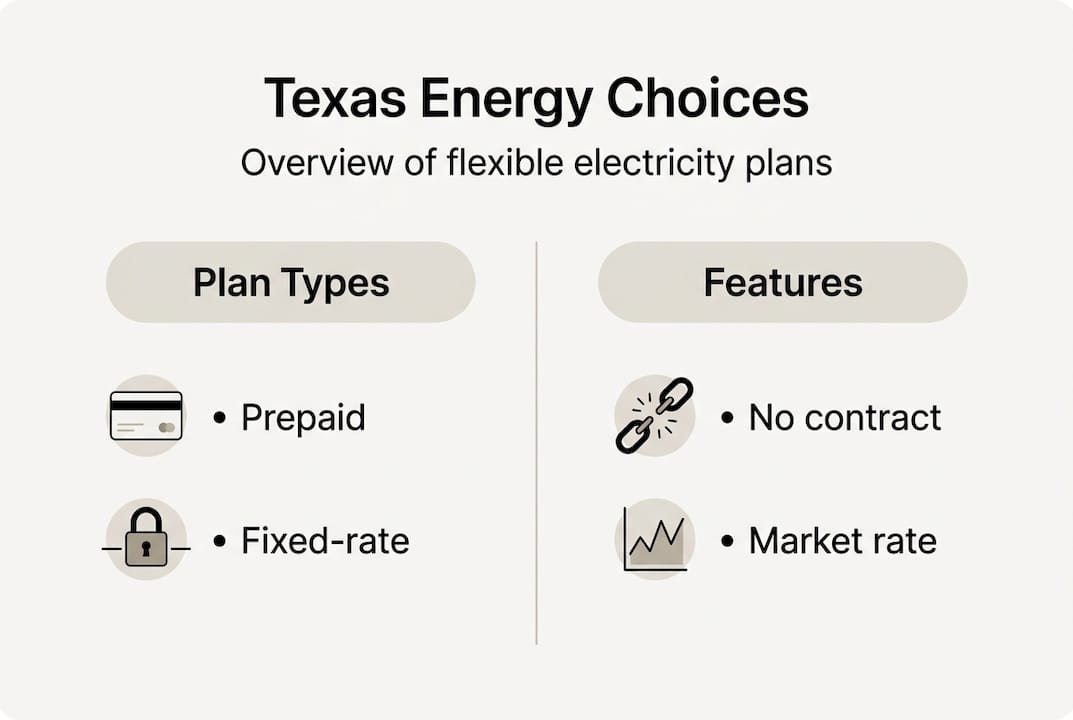
Here’s a quick side-by-side comparison:
| Plan type | Avg. rate (¢/kWh) | Credit check | Contract | Deposit |
|---|---|---|---|---|
| Prepaid | 15-20¢ | No | No | No |
| Fixed-rate | 10-14¢ | Yes | Yes | Sometimes |
| Variable-rate | Varies | Yes | No | Sometimes |
Key things to know about prepaid plans before you sign up:
- Power disconnects automatically when your balance hits $0
- Prepaid plan protections during extreme weather are more limited than with standard plans
- Not suitable for households with critical medical equipment
- Comparing prepaid vs fixed-rate plans can reveal real dollar differences in your area
Pro Tip: Always compare the per kWh rate AND any daily service fees. Some prepaid plans charge a flat daily fee on top of usage, which adds up fast for low-usage households.
Prepare your home for energy savings
Once you’ve chosen the right type of plan, making your home more efficient is the next step. You don’t need to spend thousands on upgrades. In fact, some of the most impactful improvements are completely free if you qualify for state assistance.

The Texas Weatherization Assistance Program (WAP) is one of the most underused resources in the state. It provides free home upgrades like insulation, air sealing, and HVAC tune-ups to income-qualifying households. WAP upgrades save ~$283/year on average, and you may qualify if your household income is at or below 200% of the federal poverty level. That’s roughly $60,000 for a family of four in 2026.
To apply, contact your local Community Action Agency or apply directly through the Texas Department of Housing and Community Affairs. The process involves an energy audit and income verification. Wait times vary by county, so apply early.
Even without WAP, there are low-cost fixes that make a real difference. Here’s a breakdown of common upgrades and their estimated annual savings:
| Upgrade | Avg. annual savings | Approx. cost |
|---|---|---|
| Attic insulation | $150-$200 | Free via WAP |
| Door/window sealing | $80-$120 | $10-$30 DIY |
| Smart thermostat | $100-$150 | $25-$80 |
| LED lighting swap | $50-$75 | $15-$40 |
Understanding key energy bill factors like insulation quality and appliance age can help you prioritize where to act first.
Here are five energy-saving habits you can start this week:
- Set your thermostat to 78°F when you’re home and 85°F when you’re away during summer
- Unplug devices and chargers when not in use, they still draw power in standby mode
- Run dishwashers and laundry at night when grid demand is lower
- Use ceiling fans to feel cooler without lowering the thermostat
- Close blinds on south-facing windows during peak afternoon heat
Pro Tip: Start with insulation and air sealing first. A drafty attic can add 20-30% to your cooling costs, and WAP covers this for free if you qualify.
Manage your energy usage week by week
With your home optimized, the next focus is tracking and controlling regular usage. This is especially important for prepaid customers, where a surprise zero balance means an immediate shutoff.
Start by reading your bill carefully. Look for line items beyond just the kWh charge. Common hidden fees include transmission and distribution charges, metering fees, and daily service charges. These can add $15 to $40 per month on top of your actual usage cost. Knowing factors affecting a prepaid bill helps you spot charges that seem off.
Set a weekly energy budget. If your monthly goal is $80, that’s roughly $20 per week. Most providers have apps or online portals that show your daily kWh usage. Check it every few days, not just when you get a low-balance alert.
Here’s a simple system to avoid shutoffs on prepaid plans:
- Set a low-balance alert at $20 or higher through your provider’s app or website
- Check your account balance every Monday morning as a routine
- Refill your account before the balance drops below $10, not after
- Track your highest-use days (usually the hottest or coldest of the week)
- Adjust usage habits mid-week if you’re burning through balance faster than expected
Prepaid plans disconnect at $0 balance, so active management is not optional. It’s the price of flexibility.
Pro Tip: Schedule a recurring phone reminder every Friday to check your balance. It takes 30 seconds and prevents a weekend shutoff when customer service may be harder to reach.
Navigate special programs and community resources
Beyond your own efforts, extra help is available if you know where to look. Texas has a network of programs designed to keep households powered during financial hardship, and many residents never use them simply because they don’t know they exist.
Here are the main assistance programs available to Texas residents:
- WAP (Weatherization Assistance Program): Free home upgrades for income-qualifying households. WAP can save ~$283/year for those who qualify. Apply through your local Community Action Agency.
- LITE-UP Texas: A state discount program that reduces bills for low-income customers during summer months. Check eligibility through your retail electric provider.
- CEAP (Community Services Block Grant Energy Assistance): County-level emergency bill payment assistance. Available through local social services offices.
- Church and nonprofit help: Many local churches, United Way chapters, and Catholic Charities offices offer one-time emergency energy assistance. No income threshold required in some cases.
- Critical care designation: If someone in your home depends on electrically powered medical equipment, register as a critical care customer with your utility. This adds protections against disconnection.
To navigate the Texas energy choice process and find the right program, start with 211.org, Texas’s statewide social services hotline. They can connect you with local resources fast.
Important: Texas prepaid electricity does not guarantee protection during extreme weather events. If you or a family member has serious health needs, explore critical care registration or a standard plan with stronger disconnection protections before choosing prepaid.
Apply for assistance programs before you’re in crisis. Many have wait lists or processing times of two to four weeks. Getting on the list early keeps you covered when you need it most.
What most Texans get wrong about energy savings
After covering the practical steps, it’s time for a frank look at what really matters most. The most common mistake we see is treating the lowest per-kWh rate as the only number that matters. It isn’t.
Prepaid plans cost more per kWh, but for someone who can’t pass a credit check or scrape together a $200 deposit, a fixed-rate plan isn’t actually an option. The “cheaper” plan that requires a deposit you don’t have is not cheaper at all. It’s inaccessible.
The real trap is ignoring the fine print. Residents get drawn in by a low advertised rate, then get hit with daily service fees, balance minimums, and reconnection charges after a shutoff. The hidden bill factors often matter more than the headline rate.
There’s also a protection gap that most people don’t think about until it’s too late. Prepaid plans lack full extreme weather protection and are not appropriate for critical care households. If you have a family member on home oxygen or dialysis, prepaid is not the right fit, regardless of cost.
Flexibility is genuinely valuable. No contract means you can switch when a better deal appears. But flexibility without awareness is just risk. Know what you’re trading when you choose convenience over protections, and make that trade consciously.
Get affordable, flexible electricity in Texas today
Ready to cut costs and gain control? Here’s how to get started fast. Finding a no deposit, flexible electricity plan in Texas doesn’t have to take days or involve a credit check. Many residents are surprised to learn they can have power activated the same day they apply.

Whether you’re in a smaller market like no deposit electricity in Palacios or a larger city like no credit check plans in Temple, Same Day Electricity has options built for your situation. If speed matters, explore same day flexible electricity and get the lights on today without jumping through hoops. No deposit. No credit check. No waiting.
Frequently asked questions
What is the biggest advantage of prepaid electricity in Texas?
Prepaid electricity requires no credit check and no deposit, making it the fastest and most accessible option for residents who need power activated quickly without financial barriers.
How do I apply for free weatherization upgrades in Texas?
Contact your local Community Action Agency or apply through the Texas Department of Housing and Community Affairs if your income is at or below 200% of the federal poverty level.
Can prepaid electricity be disconnected during extreme weather?
Yes. Prepaid plans disconnect at $0 and offer limited protections during extreme weather events, unlike some standard plans that have additional shutoff restrictions.
What quick steps actually lower your Texas energy bill?
Sealing air leaks and adjusting your thermostat are the fastest wins, and weatherization upgrades save ~$283/year on average for qualifying households who use the WAP program.
Recommended
- Navigate the Texas energy choice workflow in 5 steps
- Top electricity bill factors for affordable prepaid plans in Texas
- Same Day Energy Activation: Fast, Flexible Electricity
- Prepaid electricity Killeen, Texas | No credit check electricity & Payless Power
- Solar energy guide: Texas homeowner savings in 2026
- Flexible Energy Systems: Unlocking Value for Business