

TL;DR:
- No deposit electricity plans in Texas allow service without credit checks or upfront costs.
- Prepaid plans activate quickly, enabling same-day service with real-time usage monitoring.
- They offer flexible control, especially for those with poor credit or financial hardships.
Most Texas residents assume that signing up for electricity means handing over a deposit and sitting through a credit check. That assumption stops a lot of people from even shopping around. The truth is, no deposit electricity plans exist specifically to remove those barriers. Whether you have poor credit, no credit history, or you simply need power turned on today, there are real options available in Texas’s deregulated energy market. This guide walks you through what no deposit electricity actually means, how prepaid plans work, your legal protections, and how to pick the right plan without the financial stress.
Table of Contents
- What is no deposit electricity?
- How does no deposit (prepaid) electricity work in Texas?
- Comparing no deposit vs. traditional electricity plans
- Protections, risks, and smart choices for Texas prepaid electricity customers
- Why ‘no deposit’ electricity is a game-changer (and what most guides miss)
- Ready for flexible, no deposit electricity? Explore your Texas options
- Frequently asked questions
Key Takeaways
| Point | Details |
|---|---|
| No deposit plans | You can get electricity in Texas without a deposit or credit check, saving money and stress. |
| Prepaid electricity basics | Prepaid plans let you pay for power up front and reload when needed, with no long-term contracts. |
| Stay protected | Know your rights—state rules and aid programs can help you avoid costly deposits or disconnections. |
| Choose smartly | Compare plan types to pick the fastest, most flexible solution for your situation. |
What is no deposit electricity?
No deposit electricity is exactly what it sounds like: a plan that lets you start service without paying an upfront security deposit and without a credit check. Traditional postpaid electricity plans typically require providers to run your credit before they agree to serve you. If your score is low or you have no credit history at all, you either get denied or you’re asked to put down a deposit before the lights come on.
Prepaid electricity plans flip that model. Instead of paying after you use electricity, you load money onto your account before you use it. There’s no credit check because the provider isn’t extending you credit. You’re paying as you go, which removes the financial risk for both sides.
Who benefits most from no deposit plans?
- People with poor or no credit history
- New Texas residents who haven’t established local credit
- Renters who need fast service activation
- Anyone recovering from bankruptcy or financial hardship
- Customers who want full control over their monthly energy spending
Texas law actually gives some customers the right to skip deposits even on traditional plans. PUCT Rule 25.24 mandates deposit waivers for seniors aged 65 and older, customers with 12 consecutive months of on-time payments, family violence victims, and people enrolled in low-income programs like SNAP, Medicaid, TANF, or disability assistance. When deposits are required, they’re capped at one-sixth of the estimated annual bill, which typically lands between $200 and $450.
That’s still real money for someone living paycheck to paycheck. No deposit prepaid electricity plans bypass that cost entirely.
| Feature | Traditional postpaid | No deposit prepaid |
|---|---|---|
| Credit check required | Yes | No |
| Upfront deposit | $200 to $450 | $0 |
| Activation speed | 1 to 3 days | Same day |
| Billing cycle | Monthly | Pay as you go |
| Contract required | Often | Usually not |
For Texans in East Texas and other deregulated regions, no deposit electricity options are widely available and easy to activate online.
How does no deposit (prepaid) electricity work in Texas?
Now that you know what no deposit electricity is, let’s look at how these plans actually work in practice.
The sign-up process is straightforward. You go online, enter your address to confirm you’re in a deregulated service area, choose a prepaid plan, and load your initial balance. No credit check. No waiting for approval. In many cases, service activates the same day if you enroll before the provider’s cutoff time.
Here’s a step-by-step look at how the process typically unfolds:
- Enter your address to verify your utility territory (Oncor, CenterPoint, or AEP).
- Choose a prepaid plan that fits your usage habits and budget.
- Load your starting balance online or by phone.
- Receive confirmation that service is active, usually within hours.
- Monitor your balance through the provider’s app or text alerts.
- Reload as needed before your balance hits zero.
The prepaid model works like a pay-as-you-go phone plan. Your account balance decreases as you use electricity each day. Most providers send low-balance alerts by text or email so you know when to reload. This real-time feedback is actually one of the biggest advantages because you always know where you stand financially.

Understanding the factors for affordable prepaid plans helps you pick a rate that won’t drain your balance faster than expected. Things like your home’s square footage, insulation quality, and local climate all affect daily usage.
There is one edge case worth knowing. Prepaid service disconnects at a $0 balance with little notice, unlike traditional plans that may offer deferred payment arrangements. If you qualify as low-income, programs like CEAP and LIHEAP can cover deposits or electricity bills up to $1,800 per year, which gives you a meaningful safety net.
Pro Tip: Set up text alerts at a $20 balance threshold, not just $10. That extra cushion gives you time to reload even if you’re busy or traveling, and it prevents an unexpected disconnection.
Customers in cities like Temple can access prepaid services quickly through providers already operating in their utility zone.
Comparing no deposit vs. traditional electricity plans
With an understanding of how prepaid plans work, it’s important to compare them directly to traditional electricity plans.
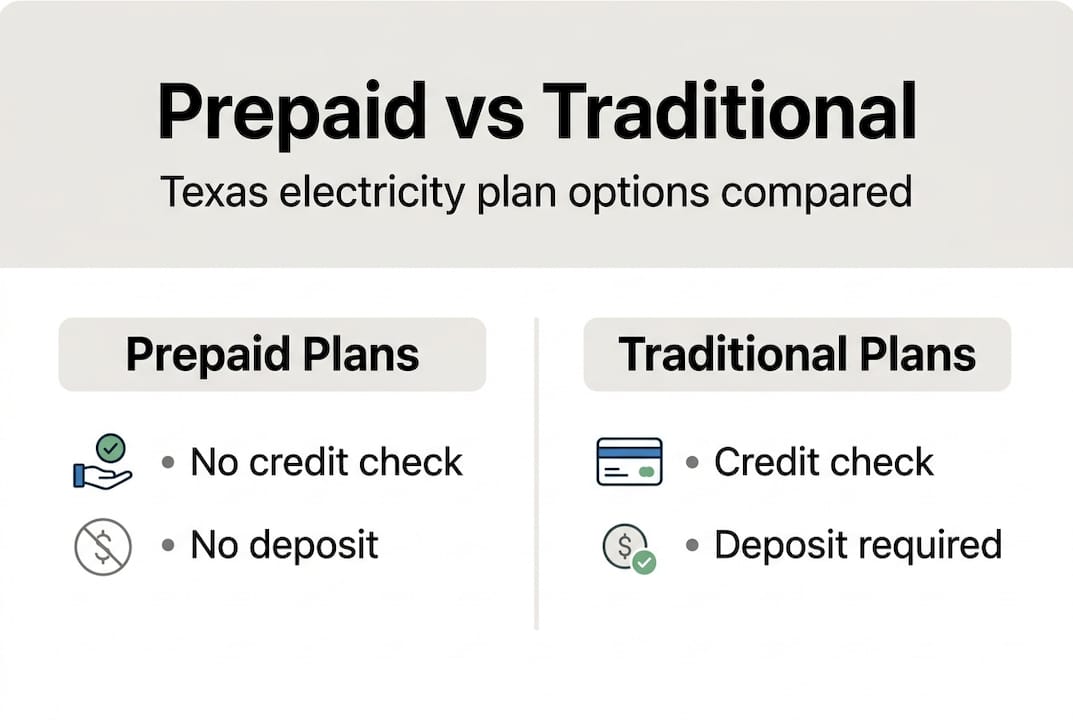
Both plan types have real advantages. The right choice depends on your financial situation, how predictable your usage is, and how much flexibility you need.
No deposit prepaid strengths:
- Zero upfront cost to start service
- No credit check or approval process
- Same-day activation in most cases
- Full control over spending with daily usage visibility
- No long-term contract in most cases
Traditional postpaid strengths:
- Fixed monthly billing for easier long-term budgeting
- May offer lower per-kilowatt-hour rates on locked-in contracts
- Deferred payment options during hardship
- Easier to forget about until the bill arrives
The financial difference at sign-up is significant. Deposits on traditional plans are capped at one-sixth of the estimated annual bill, putting most customers between $200 and $450 out of pocket before they use a single kilowatt. For someone who doesn’t have that cash available, prepaid isn’t just a preference. It’s the only realistic option.
| Factor | No deposit prepaid | Traditional postpaid |
|---|---|---|
| Startup cost | $0 | $200 to $450 deposit |
| Credit check | None | Required |
| Disconnect risk | At $0 balance | After missed bill |
| Flexibility | High | Low to medium |
| Rate type | Variable or fixed | Fixed or variable |
Keep in mind: Prepaid plans shift the disconnection risk from “missed bill” to “empty balance.” The risk is real but manageable with alerts and consistent reloading habits.
For anyone with a credit history that’s less than ideal, prepaid is the best choice for bad credit because it removes the approval barrier entirely while still delivering reliable service.
The honest downside of prepaid is that per-kilowatt-hour rates can sometimes run slightly higher than the lowest locked-in contract rates. But when you factor in the $0 startup cost versus a $300 deposit, prepaid often saves money in the short term for people who can’t absorb that upfront hit.
Protections, risks, and smart choices for Texas prepaid electricity customers
Understanding both plan types is critical, but so is knowing your rights and resources as a customer.
Texas’s deregulated electricity market comes with real consumer protections built in. The Public Utility Commission of Texas (PUCT) oversees retail electricity providers and sets rules that protect customers from unfair practices. Here’s what you should know:
Your key protections as a Texas electricity customer:
- Providers must send low-balance warnings before disconnecting prepaid service
- Disconnections are prohibited on weekends, holidays, and days when extreme weather is forecast
- You have the right to dispute billing errors and request a payment arrangement
- Seniors and medical baseline customers have additional protections against disconnection
- Deposit waivers are legally required for qualifying low-income and protected groups
If you’re struggling financially, don’t wait until your balance hits zero to look for help. CEAP and LIHEAP assistance can cover electricity bills or deposits up to $1,800 per year for qualifying low-income households. These programs are funded federally and administered locally, so availability can vary by county and season.
Customers in smaller Texas communities, like those exploring Palacios prepaid options, can still access these protections and assistance programs through their local utility and state resources.
Smart habits that protect your service:
- Reload your balance before it drops below $15
- Enable every alert your provider offers, including daily usage summaries
- Keep a small emergency reload amount saved for unexpected high-usage days
- Check your daily rate during extreme heat or cold, since usage spikes fast
- Apply for CEAP or LIHEAP early in the season before funds run out
Pro Tip: Apply for any deposit waiver or assistance program before you’re in crisis mode. These programs have limited funding and waiting lists can be long. Getting on the list early means you have a backup when you actually need it.
Budgeting your electricity like a utility bill, even though it’s prepaid, keeps you from being caught off guard. Set a weekly reload reminder the same way you’d set a reminder to pay rent.
Why ‘no deposit’ electricity is a game-changer (and what most guides miss)
Most articles about no deposit electricity focus on the features: no credit check, fast activation, pay-as-you-go. Those things are true and useful. But they miss the bigger picture.
For someone who just moved to Texas, is rebuilding after a financial setback, or is renting a first apartment without an established credit history, the ability to turn on electricity today without handing over $300 is genuinely life-changing. It’s not a workaround. It’s a legitimate, PUCT-regulated path to reliable service.
The conventional wisdom is that prepaid plans are a last resort for people who can’t qualify for “real” plans. That framing is backwards. Prepaid electricity gives you more control, more visibility, and more flexibility than most postpaid contracts. The only real risk is failing to stay on top of your balance, and that’s a habit problem, not a product problem.
We’ve seen customers use cheap Houston prepaid electricity as a long-term strategy, not just a bridge plan. Once you get used to monitoring your daily usage and reloading on your schedule, going back to a surprise monthly bill feels like a step backward.
The real win here is control. But control only pays off when you’re proactive about it.
Ready for flexible, no deposit electricity? Explore your Texas options
If you’re ready to put these strategies into action, here’s the fastest path to flexible, no deposit electricity in Texas.
Same Day Electricity makes it simple to compare and activate no deposit plans across Texas without a credit check or a long wait. Whether you’re in a major metro or a smaller city, coverage is available through Oncor, CenterPoint, and AEP service territories.

You can explore Temple no deposit plans or check out Waco prepaid electricity options by region. For a full breakdown of how same-day energy activation works, visit the site and see how fast you can get power without the deposit stress. Sign up takes minutes, and service can start today.
Frequently asked questions
Who qualifies for no deposit electricity plans in Texas?
Anyone can apply for a no deposit prepaid plan, but they’re especially designed for people with bad credit, no credit, or those who need same-day power without a credit check. PUCT Rule 25.24 also mandates deposit waivers for seniors, low-income program participants, and family violence victims on traditional plans.
How quickly can I get electricity with a no deposit plan?
Most prepaid, no deposit plans offer same-day connection if you enroll early in the day. Activation typically happens within a few hours of completing your online sign-up and loading your initial balance.
What happens if my prepaid electricity balance runs out?
Service is usually disconnected at $0 with little advance notice, but providers are required to send low-balance alerts so you have time to reload before losing power.
Are there programs to help with electricity costs or deposits?
Yes. Texas residents facing financial hardship may qualify for CEAP or LIHEAP assistance, which can cover bills or deposits up to $1,800 per year. Apply early because funding is limited and seasonal.
How much are traditional electricity deposits in Texas?
Traditional postpaid plan deposits are capped by law at one-sixth of the annual bill, which typically comes out to between $200 and $450 depending on your estimated usage.
Recommended
- Prepaid electricity: the best choice for bad credit TX
- Prepaid Electricity Texas, No Deposit Electricity, Same Day Electricity Service
- Prepaid Electricity, No Deposit Electricity East Texas | Payless Power
- Same Day Energy Activation: Fast, Flexible Electricity
- solar tax credit Archives – Alpha Solar Solutions, LLC