

TL;DR:
- Understanding bill components like TDU fees and base charges helps Texans avoid surprises.
- Comparing plans using real usage data ensures accurate, cost-effective electricity choices.
- Prepaid plans offer fast activation and no deposits, ideal for renters and those with poor credit.
Most Texans know they can pick their electricity company, but far fewer understand what actually shows up on their bill each month. The Texas electricity market is deregulated, which means you have real choices, but it also means the advertised rate and your actual bill can look very different. Base fees, delivery charges, and usage tiers all pile on top of that headline number. Understanding what drives your real rate is the fastest way to avoid bill shock, pick the right plan, and get power turned on today without paying a deposit.
Table of Contents
- How electricity rates work in Texas
- What affects your actual electricity rate?
- How to compare Texas electricity rates the right way
- How to get started: Fast, affordable electricity plans in Texas
- Why understanding your electricity rate is the ultimate money-saver
- Ready for affordable electricity in Texas?
- Frequently asked questions
Key Takeaways
| Point | Details |
|---|---|
| Texas rates explained | Your true electricity rate includes both your plan’s price and a fixed delivery fee set by your utility. |
| Comparison is key | Always check total cost at your expected usage, not just the advertised rate. |
| Choose prepaid for speed | Prepaid, no-deposit plans offer fast activation and make it easier to control your costs. |
| Use trustworthy tools | For unbiased plan comparisons, rely on PowerToChoose.org and always review the Electricity Facts Label. |
How electricity rates work in Texas
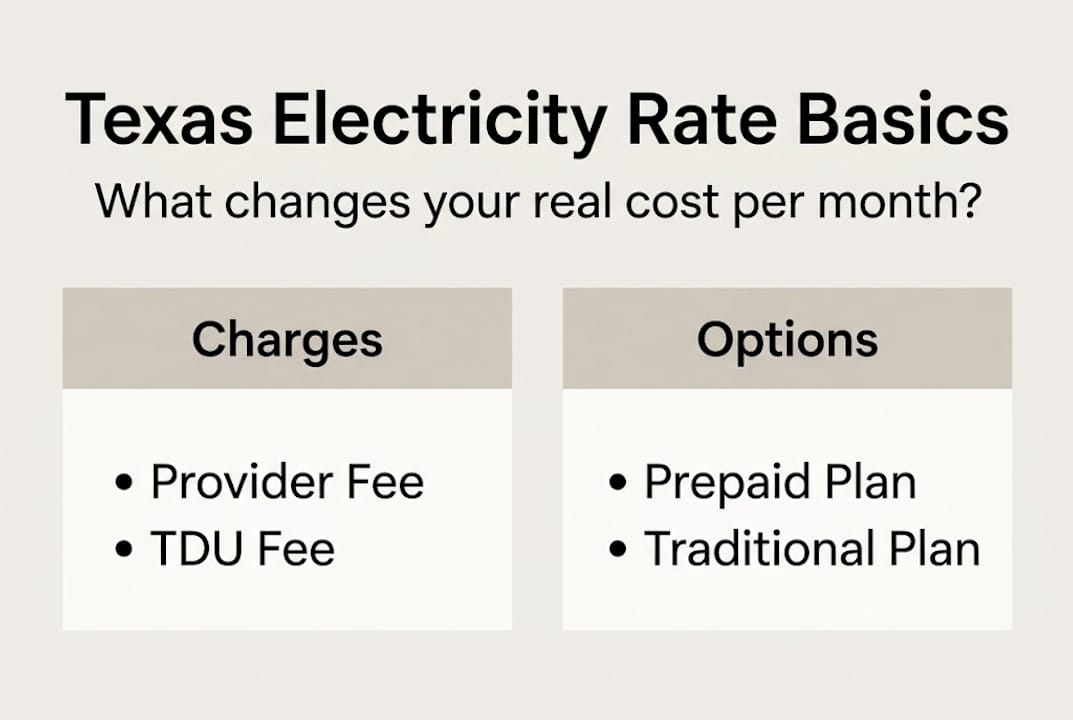
Texas runs on a two-layer system. You choose a retail electric provider (REP), the company that sells you electricity and sets your energy rate. But a separate company, your local transmission and distribution utility (TDU), physically delivers that power through the wires to your home. You never choose your TDU. It depends entirely on where you live.
This matters because Texas deregulation under Senate Bill 7 gave you the freedom to shop REPs, but TDU delivery fees are fixed by territory and always added to your bill. You cannot shop around to lower them.
Here is what makes up a typical Texas electricity rate:
- Energy charge: The per-kilowatt-hour (kWh) rate your REP charges for the electricity itself
- TDU delivery fee: A per-kWh pass-through charge from your local utility. Oncor charges roughly 3.5¢/kWh and CenterPoint roughly 4.2¢/kWh
- Base or monthly charge: A flat fee some plans charge just for having an account, regardless of usage
- Taxes and fees: State and local taxes, typically 2 to 3 percent of your total bill
To make this concrete, here is a sample bill breakdown for a home using 1,100 kWh in a month:
| Charge | Rate | Amount |
|---|---|---|
| Energy charge (REP) | 8.5¢/kWh | $93.50 |
| TDU delivery fee (Oncor) | 3.5¢/kWh | $38.50 |
| Base monthly charge | Flat | $9.95 |
| Taxes and fees | ~2.5% | $3.55 |
| Total bill | $145.50 |
That headline rate of 8.5¢ becomes roughly 13.2¢ per kWh all-in once everything stacks up. Understanding these electricity bill factors before you sign up is what separates a good deal from a frustrating surprise. Texans looking at Temple electricity plans or any other city should always run this same math.
Stat callout: Texas rates sit below the national average thanks to market competition, but the plan details, not the advertised number, drive your real monthly cost.
What affects your actual electricity rate?
Knowing what is in your bill is step one. Step two is understanding why your rate can change from month to month even on the same plan.

Here is a quick comparison of the three main plan types you will encounter in Texas:
| Plan type | How rate is set | Pros | Cons |
|---|---|---|---|
| Fixed rate | Locked for contract term | Predictable bills | Early termination fees |
| Variable rate | Fluctuates with market | No long-term commitment | Weather and gas prices can spike your bill |
| Prepaid | Pay as you go, no contract | No deposit, no credit check | Requires account monitoring |
Beyond plan type, four things drive what you actually pay each month:
- Usage matters: Many plans advertise a low rate that only applies if you use above 1,000 kWh. Use less and a higher tier kicks in.
- Plan type matters: Fixed plans protect you from market swings. Variable and indexed plans do not.
- Delivery territory: Your TDU determines a chunk of your bill. Moving from an Oncor area to a CenterPoint area changes your delivery cost.
- Market conditions: Natural gas prices and extreme weather events push wholesale electricity costs up, which flows into variable and indexed plans fast.
Pro Tip: Always compare plans using your actual monthly usage. The typical Texas home uses between 1,100 and 1,140 kWh per month. Plug that number into any comparison tool to get a realistic picture of what you will pay. Reviewing the factors affecting your rate before committing to a plan can save you real money every month.
“PUCT-mandated Electricity Facts Label (EFL) ensures transparency. Always review your rate at your expected usage level before signing up for any plan.”
If you are weighing whether a traditional plan or a prepaid plan fits your situation better, the EFL is your best tool for an honest side-by-side look.
How to compare Texas electricity rates the right way
Most Texans pick a plan based on the big number in the ad. That is exactly how providers get away with charging more than expected. A real comparison takes about ten minutes and can save you hundreds of dollars a year.
Here is how to do it correctly:
- Get the Electricity Facts Label (EFL): Every Texas REP is required to provide one. It shows your rate at 500, 1,000, and 2,000 kWh. Focus on the 1,000 kWh column for a realistic read.
- Add TDU charges manually: The EFL may or may not include TDU fees. Confirm whether they are baked in or separate.
- Check for base charges: A $9.95 monthly base charge adds nearly $120 per year to your bill before you use a single kWh.
- Use 1,100 kWh as your benchmark: Average Texas usage is 1,100 kWh per month. Comparing at this level gives you an apples-to-apples cost.
- Run your numbers on PowerToChoose: The Texas bill comparison tool is state-run and unbiased. PowerToChoose lists every certified REP with EFL links so you can compare transparently.
Pro Tip: Ignore any plan that advertises a rate only available at 2,000 kWh or higher. Unless you run a large home with heavy AC use year-round, you will never hit that tier and will pay a much higher rate instead.
Stat callout: The average Texas home uses 1,100 kWh per month. Always compare rates at this usage level to get an accurate monthly cost estimate.
When you are managing energy costs on a tight budget, this comparison step is not optional. It is the difference between a plan that works for you and one that quietly drains your wallet. If you are looking at no deposit plans or want to compare all available plans in your area, start with the EFL and the 1,100 kWh benchmark every time.
How to get started: Fast, affordable electricity plans in Texas
Once you know how to read a rate and compare plans honestly, getting service started is straightforward. Prepaid and same-day plans are specifically built for speed. No waiting on credit checks. No deposit sitting in someone else’s account.
Here is how the process works for most same-day prepaid plans:
- Choose your plan: Pick a prepaid plan that covers your city and fits your usage. Review the EFL to confirm the all-in rate.
- Provide your ID: A valid government-issued ID is typically all you need. No Social Security number required for most prepaid options.
- Add funds to your account: Load a starting balance. Many providers require a minimum of $20 to $40 to activate service.
- Get power within hours: Once your account is funded and your meter is enrolled, service typically activates the same day.
Same-day prepaid plans are built to help you skip the deposit, get power fast, and stay in control of your costs through real-time usage tracking.
These plans work especially well for:
- Renters who move frequently and do not want long-term contracts
- New Texas residents who have not yet built a local credit history
- Anyone with poor or limited credit who would otherwise face a deposit of $150 to $300 or more
- People who want budget control through daily balance alerts and flexible top-ups
Before you pay your first dollar, review the final rate breakdown one more time. Look for any daily connection fees, minimum usage charges, or base fees that apply even on low-usage days. Understanding your no deposit electricity options fully before activation means no surprises on day one. If credit has been a barrier in the past, prepaid electricity for bad credit is a practical path forward that does not require a perfect financial history.
Why understanding your electricity rate is the ultimate money-saver
Here is something most Texans never realize: the energy market in Texas is genuinely competitive, but it only works in your favor when you know how to read it. Most people chase the lowest advertised number and end up paying more than a neighbor who took ten extra minutes to check the EFL.
The real savings do not come from luck or timing. They come from understanding that your rate is not a single number. It is a formula that shifts with your usage, your territory, and the plan structure you chose. A plan with a low energy charge but a high base fee can cost more than a plan with a slightly higher energy charge and no base fee, depending on how much you use.
Treat your first rate review as a one-time investment. Spend thirty minutes learning your TDU territory, pulling EFLs, and running the 1,100 kWh comparison. That investment pays you back every single month. Pairing that knowledge with smart energy cost strategies puts you firmly in control of your bill instead of reacting to it.
“Energy competition in Texas works for you, if you know how to compare plans the smart way.”
Ready for affordable electricity in Texas?
Now that you know how Texas rates actually work, you can put that knowledge to use immediately. Same Day Electricity offers no-deposit, no credit check prepaid plans across Texas, and most customers have power activated the same day they sign up.

Whether you are in a smaller community like Palacios or looking for Temple no deposit plans, we make it simple to review your all-in rate, fund your account, and get the lights on fast. Transparent pricing, flexible payments, and same-day energy activation are built into every plan. No surprises, no waiting, no deposit required.
Frequently asked questions
What is an electricity rate in Texas?
An electricity rate is the price you pay per kilowatt-hour for power from your chosen provider, plus the TDU delivery fees and taxes that stack on top. Your all-in rate is almost always higher than the advertised energy charge alone.
Why are advertised electricity rates sometimes different from my bill?
Advertised rates often exclude base fees, TDU delivery charges, and usage-based tiers. Always check the EFL at your expected usage to see the true cost before signing up.
How can I get electricity fast with no deposit in Texas?
Choose a prepaid same-day plan that does not require a credit check or deposit, fund your account, and service typically activates within hours of enrollment.
What is a TDU charge?
It is the per-kWh fee your local utility charges for physically delivering electricity to your home. TDU fees are fixed by territory and added to every bill regardless of which REP you choose.
Where can I compare Texas electricity rates unbiasedly?
Use PowerToChoose.org to view all certified Texas plans side-by-side and filter by your typical monthly usage for an accurate cost comparison.