

TL;DR:
- Variable rate electricity in Texas changes monthly based on ERCOT wholesale market prices.
- No-deposit, flexible plans benefit those with poor credit or needing same-day activation.
- Managing volatility involves usage monitoring, pre-cooling, and tracking rates to avoid surprises.
Your Texas electricity bill can swing dramatically from one month to the next, and most residents have no idea why. Variable rate electricity sits at the center of that confusion. Many assume these plans are traps designed to spike your bill without warning. But that assumption misses something important: for the right person, a variable rate plan can mean same-day power with no deposit and no credit check. This guide breaks down exactly how variable rate electricity works in Texas, what the real risks look like, and how to protect yourself while taking advantage of the flexibility these plans offer.
Table of Contents
- How variable rate electricity works in Texas
- Benefits and risks: Variable vs. fixed-rate electricity plans
- When to choose variable rate electricity in Texas
- Managing bill volatility and avoiding surprises
- The real opportunity: Why flexible, no-deposit plans are changing Texas
- Start your flexible electricity plan in Texas today
- Frequently asked questions
Key Takeaways
| Point | Details |
|---|---|
| Flexible activation | Variable rate electricity plans allow fast, no-deposit setup for Texas residents. |
| Monthly rate changes | Rates adjust each month based on ERCOT wholesale trends, so bills can vary. |
| Bill volatility risk | Weather events and grid issues can cause temporary spikes in variable electricity costs. |
| Smart monitoring matters | Staying alert to usage and rate updates is essential for avoiding bill surprises. |
| Tailored for credit concerns | Variable plans are especially good for those with credit challenges or seeking to avoid deposits. |
How variable rate electricity works in Texas
Variable rate electricity is exactly what it sounds like. Your rate per kilowatt-hour (kWh) changes over time rather than staying locked in at a fixed price. In Texas, those changes are tied directly to what happens in the wholesale energy market.
Texas runs its own power grid through ERCOT, the Electric Reliability Council of Texas. ERCOT manages the flow of electricity across most of the state and sets wholesale prices based on real-time supply and demand. Those Texas electricity rates shift constantly throughout the day. Providers adjust rates tied to ERCOT wholesale prices, updated every 15 minutes, with retail rates typically changing monthly to reflect prior averages or defined formulas.
What that means for you: your retail electricity provider looks at what wholesale power cost over the previous period, then calculates your new monthly rate. Some providers use a simple average. Others apply a percentage markup above wholesale. Either way, you will not know your exact rate until the new billing cycle begins.
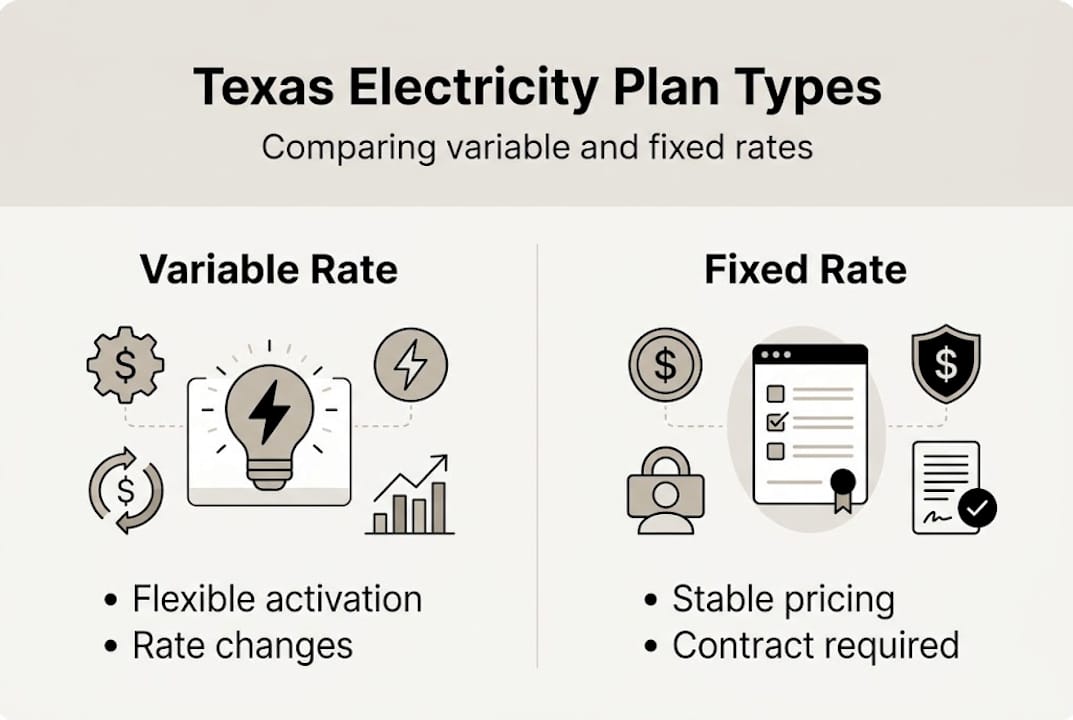
Here is a simplified look at how rates can shift across seasons:
| Season | Typical wholesale pressure | Impact on variable rate |
|---|---|---|
| Summer (June to August) | High demand, heat-driven | Rates often rise |
| Winter (December to February) | Weather-driven spikes possible | Rates can spike sharply |
| Spring/Fall | Lower demand | Rates often drop |
| Storm events | Extreme demand surges | Rates can spike severely |
Key factors that drive your monthly rate change include:
- Extreme weather pushing up demand across the grid
- Fuel costs for natural gas and coal plants feeding ERCOT
- Grid congestion in specific regions causing localized price spikes
- Unexpected plant outages reducing available supply
- Seasonal demand cycles from air conditioning and heating loads
Understanding these mechanics is the first step toward managing energy costs without getting blindsided. Variable rate plans are not random. They follow real market forces. Once you understand those forces, you can make smarter decisions about when and how to use them.
Benefits and risks: Variable vs. fixed-rate electricity plans
Now that you know how variable rates work, let’s examine whether they’re right for your situation compared to fixed-rate options.
Variable rate plans carry a reputation for being risky, and that reputation is not entirely wrong. Rates spike during peaks; Winter Storm Uri in 2021 left some customers with variable bills exceeding $7,000, and 2026 events saw localized prices hit $28,000 per MWh due to grid congestion and forecast errors. Those numbers are real. But they are also the extreme end of the spectrum.

For many Texas residents, variable plans offer advantages that fixed-rate plans simply cannot match. Here is an honest comparison:
| Feature | Variable rate plan | Fixed-rate plan |
|---|---|---|
| Deposit required | Typically none | Often required |
| Credit check | Usually not needed | Commonly required |
| Activation speed | Same day possible | May take 1 to 3 days |
| Monthly bill predictability | Low | High |
| Risk of price spike | Present | None |
| Flexibility to switch | High | May have cancellation fees |
Variable rate plan advantages:
- No deposit required, which protects your savings
- Prepaid electricity benefits include no credit check and instant access
- Fast activation, often on the same day you apply
- No long-term contract locking you in
- Freedom to switch plans when better options appear
Variable rate plan disadvantages:
- Monthly bills can fluctuate, making budgeting harder
- Extreme weather events can cause serious bill affordability factors to collide
- You carry the market risk rather than the provider
No deposit plans are especially valuable if you are moving into a new place quickly, rebuilding your credit, or simply cannot afford a $150 to $300 deposit upfront. The tradeoff is accepting some price uncertainty each month.
Pro Tip: Set a personal budget ceiling for your monthly electricity spend. If your variable rate pushes you close to that ceiling, reduce usage immediately rather than waiting for the bill to arrive.
When to choose variable rate electricity in Texas
With pros and cons in mind, let’s get practical. Here is when variable rate electricity really shines for Texas residents.
Not every situation calls for a fixed-rate plan. Variable rate electricity is genuinely the better choice in several common scenarios. Retail rates change monthly based on ERCOT wholesale price averages, so timing and awareness matter more than most people realize.
Here are the situations where a variable plan makes the most sense:
- You need power today. If you are moving in and the lights need to be on by tonight, same day activation through a variable or prepaid plan is often your fastest path.
- Your credit history is limited or damaged. Fixed-rate plans from major providers frequently require a credit check. Variable and prepaid plans skip that step entirely.
- You cannot pay a deposit upfront. Deposits for fixed-rate plans can run $150 to $300 or more. Variable plans typically require no deposit at all.
- You want month-to-month flexibility. If you are renting short-term or unsure how long you will stay, locking into a 12-month contract creates unnecessary risk.
- You want to test a provider before committing. Starting on a variable plan lets you evaluate service quality before signing a longer agreement.
Getting started with a variable plan is straightforward:
- Choose a provider offering variable or prepaid plans in your area
- Confirm your utility territory (Oncor, CenterPoint, or AEP)
- Submit your address and identification, no credit check required
- Fund your account if using a prepaid option
- Activate service, often within hours
Pro Tip: Use a prepaid variable plan for instant access with zero deposit. You load money onto your account and use electricity as you go, which also helps you stay aware of your choosing energy plans options as your situation changes.
Managing bill volatility and avoiding surprises
Variable plans can create real opportunities, but managing volatility is essential. Here is how to stay ahead and avoid surprises.
The biggest risk with variable rate electricity is not the rate itself. It is being caught off guard. A rate increase you know about in advance is manageable. A surprise bill you cannot pay is a crisis.
“2026 price spike events reached $28,000/MWh due to congestion and forecast errors, highlighting the importance of active monitoring for variable rate customers.” ERCOT price spike analysis
Smart energy cost management starts with knowing what drives volatility. Weather is the biggest factor in Texas. When temperatures hit extremes, demand surges and prices follow. Grid congestion, fuel supply disruptions, and unexpected plant outages also push prices up fast.
Here are practical steps to protect yourself:
- Set up usage alerts through your provider’s app or online account so you know when consumption spikes
- Track your rate each month by checking your provider’s rate notice before the billing cycle closes
- Use a prepaid account to cap your spending naturally. When the balance runs low, you add more rather than accumulating a large bill
- Reduce usage during peak hours (typically 3 p.m. to 7 p.m. on weekdays) to avoid the highest-cost periods
- Watch weather forecasts before extreme heat or cold events and pre-cool or pre-heat your home during cheaper overnight hours
- Explore monitoring energy use tools that track real-time consumption and flag unusual patterns
For residents interested in longer-term energy strategy, understanding energy investment options can also provide context on how broader market forces affect retail pricing over time.
The key insight most people miss is that volatility is predictable in pattern, even if not in exact amount. Texas summers will always push prices higher. Severe winter storms will always create spike risk. Building those realities into your habits makes variable rate electricity far less intimidating.
The real opportunity: Why flexible, no-deposit plans are changing Texas
Here is a perspective most energy articles skip entirely. Variable rate plans are not just a cost-saving tool. They are an access tool. For years, the deposit and credit check requirements of traditional electricity plans quietly locked out a large portion of Texas residents from the best available options. If your credit took a hit after a job loss or medical bills, you were often stuck with the most expensive or least flexible choices.
No-deposit, variable rate plans changed that equation. They opened the market to people who were previously treated as high-risk simply because of a credit score. That is genuinely significant.
The contrarian view worth considering: bill unpredictability, which most people see as a pure negative, can actually push you toward smarter energy habits. When your bill is fixed, there is little incentive to monitor usage. When it varies, you pay attention. Customers on prepaid plan options often develop better awareness of their consumption than those on fixed contracts, simply because the feedback loop is tighter. The discomfort of uncertainty can become a genuine advantage if you use it as motivation to monitor and reduce waste.
Start your flexible electricity plan in Texas today
If this guide helped you see variable rate electricity differently, the next step is simple: find a plan that fits your life right now, not one that requires perfect credit or a large upfront payment.

Same Day Electricity offers same day activation service across major Texas regions, including areas served by Oncor, CenterPoint, and AEP. Whether you need power today or want to explore no deposit electricity options without a credit check, the process is fast and straightforward. You can also browse energy cost solutions to find the plan that gives you the most control over your monthly spending. No credit check. No deposit. Just power when you need it.
Frequently asked questions
How often do variable electricity rates change in Texas?
Variable electricity rates typically update every month, based on ERCOT wholesale price averages from the prior period. Wholesale prices themselves update every 15 minutes, but your retail rate reflects a monthly calculation.
Can variable rate plans lead to unexpected high bills?
Yes. Severe weather and grid congestion can trigger sharp rate spikes. Winter Storm Uri bills exceeded $7,000 for some variable rate customers in 2021, and 2026 events pushed localized prices to $28,000 per MWh.
Who should consider variable rate electricity plans?
Variable rate plans are ideal for Texas residents who need fast activation, want to avoid a deposit, or have credit challenges. They are especially practical for short-term renters and those exploring affordable prepaid options.
What safeguards help manage bill volatility?
Usage alerts, prepaid spending limits, and real-time monitoring apps are the most effective tools. Checking your provider’s rate notice each month and reducing usage during peak hours also helps you stay within your budget on flexible energy plans.