

TL;DR:
- Many Texans believe bad credit prevents electricity service, but prepaid plans offer fast, deposit-free connection options. Traditional providers require deposits for low credit, triggered by late payments or no credit history, while prepaid plans bypass credit checks entirely. Choosing prepaid electricity gives you control, transparency, and immediate service without the burden of deposits or credit concerns.
Many Texans assume that bad credit means no electricity. That’s simply not true, but the reality is still frustrating. When you apply for service through a traditional retail electricity provider, your credit score gets checked, and if it falls below their threshold, you’re hit with a security deposit before your lights ever turn on. This guide breaks down exactly why that happens, what rules allow it, and most importantly, how you can choose electricity with no credit and get power running fast without jumping through expensive hoops.
Table of Contents
- How your credit affects electricity in Texas
- Why do providers require deposits—and what triggers them?
- Comparing traditional and prepaid electricity options
- How to get electricity with low or no credit fast
- Why focusing on transparency and flexibility beats credit score stress
- Ready to get flexible electricity with no credit hassle?
- Frequently asked questions
Key Takeaways
| Point | Details |
|---|---|
| Low credit means deposits | Traditional Texas providers ask for deposits if your credit score is low. |
| Prepaid skips credit checks | Prepaid electricity lets you get power quickly without a deposit or credit check. |
| You can get same-day power | Prepaid providers enable fast connection, so you won’t be left in the dark—even with poor credit. |
| Transparency helps budgeting | Prepaid plans offer real-time usage info, giving you control over costs. |
| Options exist for all Texans | Regardless of credit, there’s a flexible electricity solution available for you. |
How your credit affects electricity in Texas
Texas operates a deregulated energy market. That means you get to pick your own retail electricity provider, which sounds great until your credit becomes a barrier. When you enroll, most traditional providers pull your credit history to evaluate your financial risk. It’s similar to renting an apartment. If your score looks risky to them, they protect themselves before turning on your service.
The Public Utility Commission of Texas, known as PUCT, sets the rules for how this works. PUCT rules include “credit requirements” and “initial deposits,” laying out exactly when deposits can be requested based on a customer’s creditworthiness. This isn’t random provider behavior. It’s built into Chapter 25 of the substantive rules governing electric service providers across the state.
Here’s a quick overview of how credit levels typically play out during electricity enrollment:
| Credit level | What usually happens |
|---|---|
| Excellent (750+) | No deposit required, immediate enrollment |
| Fair (600 to 749) | May or may not require deposit depending on provider |
| Poor (below 600) | Deposit typically required before service begins |
| No credit history | Treated similarly to poor credit; deposit often required |
| Previous service interruptions | Deposit almost always required |
The key terms you’ll want to know: prepayment means paying for electricity before you use it; a deposit is a lump sum held by the provider as a safety net; and a credit check is the review of your financial history during enrollment. If you want to follow a clear path through all of this, the enrollment guide for poor credit walks through each step in plain terms.
One thing that surprises people is that your credit score doesn’t have to be dramatically low to trigger a deposit. Even a fair score with some recent late payments or a thin credit file can push a provider to request one.
Why do providers require deposits—and what triggers them?
Electricity providers are running a business, and postpaid electricity is essentially a credit arrangement. They deliver your energy now and collect payment later. If you don’t pay, they can’t easily recover that lost revenue. A deposit is their cushion.
The logic makes sense from a provider’s standpoint, but it creates a real barrier for people who are already managing tight finances. Low credit triggers a deposit requirement rather than an outright denial, which is at least somewhat reassuring. You’re not being turned away. You’re being asked to put money down first.
Here are the most common triggers that lead to a deposit request:
- Late or missed payments on your credit report. Even one or two late utility payments in your history can flag you as higher risk.
- No established credit history. Young adults or people new to the U.S. often face this. No credit history is treated almost identically to poor credit.
- Previous electricity service interruptions. If you’ve had power cut off before due to non-payment, providers can see this.
- Bankruptcy or public records. Major financial events raise red flags across the board.
- Low overall credit score. Even without specific negative marks, a score below a provider’s threshold is enough.
Some providers do offer alternative options. A letter of guarantee, where someone with good credit co-signs your account, can sometimes replace a cash deposit. Not every provider accepts this, but it’s worth asking.
Pro Tip: Before agreeing to a deposit, ask the provider directly: “What other options do I have to qualify without a deposit?” Some providers will offer alternatives they don’t advertise upfront. The worst they can say is no, and you’ve lost nothing by asking.
The cleanest way to sidestep all of this is to look at no credit check electricity options from the start. These plans are built for exactly the situation most low-credit Texans face.
Comparing traditional and prepaid electricity options
Understanding your alternatives is where things get genuinely useful. You have two main models to choose from in Texas: traditional postpaid plans and prepaid plans. They operate very differently, and the differences matter a lot when credit is a concern.
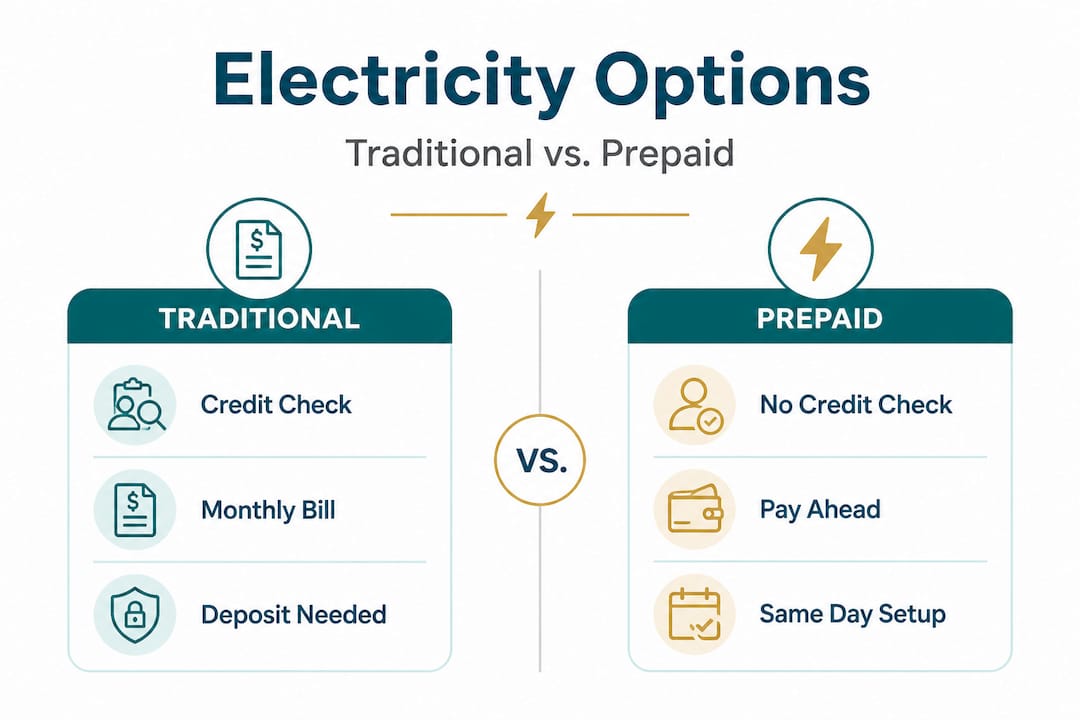
Traditional postpaid plans work like a monthly bill. You use electricity all month and pay at the end. Credit checks happen at enrollment, deposits are required for low-credit applicants, and contracts may lock you in for a year or more. Breaking a contract can come with fees.
Prepaid plans work like a pay-as-you-go phone. You load money onto your account before using electricity. Prepaid electricity plans typically do not require a credit check or deposit, making them a real and practical alternative for low-credit customers. You stay in control because you can see your balance, monitor usage, and add funds whenever you need to.
Here’s how the two models compare side by side:
| Feature | Traditional postpaid | Prepaid electricity |
|---|---|---|
| Credit check required | Yes | No |
| Deposit required (low credit) | Often $150 to $350 | No |
| Contract length | Often 12 to 24 months | Month-to-month or flexible |
| Enrollment speed | 1 to 3 days | Often same day |
| Usage transparency | Monthly bill only | Real-time notifications |
| Budget control | Limited | High |
| Risk of surprise bills | Common | Low |
Who benefits most from each option? Prepaid electricity is the better fit if you:
- Have a credit score below 600 or no credit history
- Can’t afford a $200+ upfront deposit
- Need power connected today or tomorrow
- Want to avoid long-term contracts
- Prefer to see exactly what you’re spending in real time
Traditional postpaid plans work well if you have strong credit, a stable income, and want the simplicity of one monthly bill.
Pro Tip: Use prepaid electricity for bad credit as a starting point, not a permanent compromise. Many people start with prepaid because it’s the fastest, most accessible option, and end up staying because they actually prefer the control and transparency it offers.
For Texans who want getting electricity with no credit to be as painless as possible, prepaid plans remove nearly every traditional barrier. And with fast, flexible Texas power providers available statewide, there’s no reason to let credit stand between you and your lights.
How to get electricity with low or no credit fast
Now that you understand the system and your options, let’s talk about exactly how to take action. The process is more straightforward than most people expect, especially if you go the prepaid route.
Retail electric providers use credit requirements and deposit rules during enrollment, but prepaid options are specifically designed to help you skip those steps entirely. Here’s how to get connected quickly:
-
Gather your documents before you start. You’ll need a government-issued photo ID such as a driver’s license or state ID, your service address, and proof of address if your ID doesn’t match. Having these ready prevents delays.
-
Locate your ESID or meter number. Your Electric Service Identifier (ESID) is a unique number tied to your specific address. You can find it on a previous electricity bill or by asking your apartment manager. Some providers can look it up for you with just your address.
-
Choose a no credit check provider. Look specifically for providers offering same-day electricity without credit activation. Confirm they serve your area and your utility territory.
-
Sign up online or by phone. Most no-deposit prepaid providers let you enroll entirely online in under 10 minutes. You pick your plan, enter your information, and make an initial deposit to your prepaid account to get started.
-
Make your initial prepayment. Unlike a traditional deposit, this money goes toward your actual electricity usage, not a held reserve. You’re not losing that money. You’re spending it on power.
-
Confirm your connection time. Some providers activate service within a few hours. Others connect the next business day. Ask specifically about the timeline when you sign up.
Pro Tip: Before enrolling, confirm your meter is a smart meter compatible with prepaid service. Most modern Texas meters are, but if you’re in an older building or a rural area, it’s worth a quick check. Your utility company (Oncor, CenterPoint, or AEP depending on your region) can confirm this for free.
If you’re in eastern Texas and wondering about local options, no deposit electricity East Texas covers service availability specifically for that region.
The documents you’ll typically need for prepaid enrollment:
- Photo ID: Driver’s license, state ID, or passport
- Service address: The exact address where you need electricity
- ESID number: If available, this speeds things up
- Contact information: Email and phone number for usage alerts
- Initial prepayment: Usually as low as $25 to $50 to activate
The entire process, start to finish, can happen in under 20 minutes if your documents are ready. That’s a significant difference from traditional enrollment, which can take days and still require you to wire or deliver a deposit.
Why focusing on transparency and flexibility beats credit score stress
Here’s an opinion worth sitting with: the credit check system for electricity was never really designed with everyday working Texans in mind. It was designed for providers. The deposit requirement protects the company, not you. And yet, for years, the conversation has been framed as something you need to “get past” or “overcome,” as if low credit is a personal failure rather than a circumstance.
We think that framing is backward. The better question isn’t “how do I pass a credit check?” It’s “why am I letting a credit check gatekeep something as essential as electricity?”
Prepaid electricity doesn’t just solve the deposit problem. It actually gives you something traditional plans never did: real control. When you get a low balance notification at 3 a.m., you know exactly where you stand. You’re not waiting for a bill surprise at the end of the month. You load what you can afford, you watch your usage, and you make decisions in real time. That’s not a consolation prize. That’s a better way to manage a utility.
The industry is slowly recognizing this. Prepaid options are expanding, real-time usage data is becoming standard, and the stigma around “credit check alternatives” is fading. What used to feel like a backup option for people in tough spots is now a legitimate first choice for anyone who values getting power despite low credit without handing over control to a monthly billing cycle.
The uncomfortable truth is that the families who need electricity the most, people already stretched thin, are the ones traditional systems penalize with upfront deposits. That’s not a reason to feel stuck. It’s a reason to choose differently.
Ready to get flexible electricity with no credit hassle?
You’ve now got the full picture: how credit affects your options, why deposits get triggered, and exactly how to get connected without them. The next step is simple.

Same Day Electricity makes it easy to start service today without a credit check or a large deposit. Whether you need no credit, no deposit electricity for a new address or want to switch away from a plan that’s weighing you down with bills and contract fees, there’s a straightforward path forward. Explore no deposit electricity Texas options built specifically for Texans who want flexibility without the financial stress. And if you need power running today, same day energy activation gets you connected fast, often within hours. Getting started takes less time than you’d expect.
Frequently asked questions
Will my electricity be turned away if I have bad credit in Texas?
No. Low credit triggers a deposit request from traditional providers, not an outright denial, and prepaid electricity providers offer service without any credit check at all.
How much is a typical electricity deposit for low credit in Texas?
Deposit amounts vary by provider and your estimated usage, but most low-credit applicants in Texas are asked to pay between $150 and $350 upfront to start service with a traditional provider.
Can I get electricity with no credit check or deposit the same day?
Yes. Many prepaid electricity providers offer same-day activation without credit checks or deposits, making fast connection possible for nearly anyone who needs power immediately.
What documents do I need to set up prepaid electricity?
You’ll typically need a government-issued photo ID and your service address. No credit check is required, so there’s no need to pull financial records or pay a deposit before your account is active.
Does paying a deposit improve my credit score?
No. Electricity deposits are not reported to credit bureaus, so paying one does not build or improve your credit score in any way.