

TL;DR:
- Prepaid electricity in Texas requires no credit check or deposits, enabling fast activation.
- It works by loading funds onto an account, which are used as you consume power.
- Managing balances actively is essential to avoid service disruption but offers better budget control.
Getting electricity connected in Texas should not take days or require a credit score that looks like a perfect report card. Yet thousands of Texans with poor credit or limited savings hit a wall when traditional providers demand deposits ranging from $100 to $300 before flipping the switch. Prepaid, no deposit electricity plans cut through that barrier entirely. No credit check, no waiting for approval, and no large upfront payment sitting in someone else’s account. This guide walks you through exactly how prepaid power works, what you need to sign up, and how to stay connected without stress.
Table of Contents
- Understand no deposit energy: How prepaid power works
- What you need before starting with prepaid energy
- Step-by-step: How to sign up and activate no deposit electricity in Texas
- Costs, comparison, and staying powered: Managing your prepaid plan
- The real pros and cons nobody tells you: Editorial perspective
- Get started with fast, no deposit electricity in Texas
- Frequently asked questions
Key Takeaways
| Point | Details |
|---|---|
| No deposit needed | Prepaid energy lets you skip credit checks and upfront deposits for fast electricity setup. |
| Simple activation steps | With the right info and payment, you can get your power on the same day. |
| Control your budget | Track usage in real time to avoid surprise bills and stay connected. |
| Short-term savings | Many find prepaid energy is cheaper up front, though it requires more active management. |
Understand no deposit energy: How prepaid power works
Prepaid electricity works a lot like a prepaid phone plan. You load money onto your account, your provider draws from that balance as you use power, and you top up whenever you need to. There is no monthly bill arriving at the end of the cycle, no late fees, and no credit check standing between you and a working refrigerator.
Traditional electricity plans run on a post-pay model. You use power all month, then receive a bill 30 days later. Providers protect themselves by pulling your credit history and charging a security deposit if your score is below their threshold. For someone dealing with medical debt, past evictions, or simply a thin credit file, that deposit can feel impossible.
Prepaid plans avoid credit checks and deposits entirely, which means budget control stays in your hands from day one. The basic workflow looks like this:
- Pay upfront: Load a minimum starting balance, often between $20 and $50 depending on the provider.
- Use power normally: Your balance decreases as you consume electricity each day.
- Get alerts: Most providers send texts or app notifications when your balance runs low.
- Top up anytime: Add funds online, by phone, or at a retail location to keep power running.
Who benefits most from this setup? Renters who move frequently and cannot afford multiple deposits, people rebuilding credit after financial setbacks, and anyone who needs power activated fast without paperwork delays. Understanding how prepaid plans work helps you see why this model has grown popular across deregulated Texas markets.
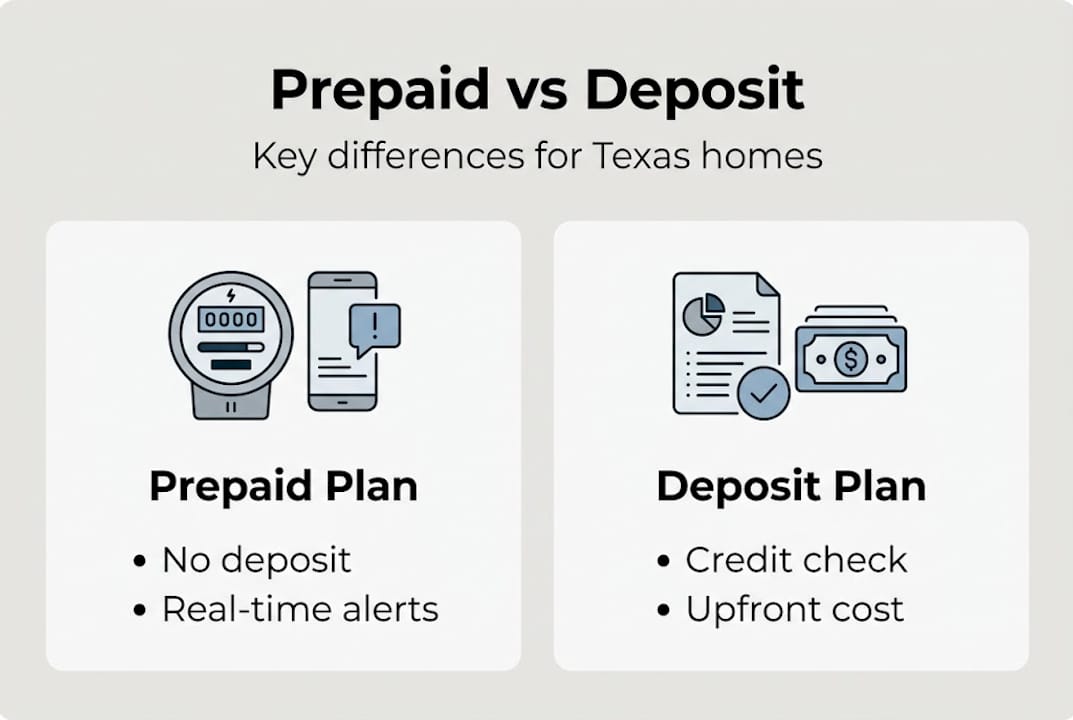
| Feature | Prepaid plan | Traditional deposit plan |
|---|---|---|
| Credit check required | No | Yes |
| Upfront deposit | None | $100 to $300+ |
| Monthly bill | No | Yes |
| Activation speed | Often same-day | 1 to 3 business days |
| Budget control | Real-time | End of month |
Pro Tip: If you rent and move often, prepaid plans are especially valuable because you avoid losing a deposit every time you transfer service to a new address.
What you need before starting with prepaid energy
Getting set up with a prepaid plan is genuinely fast, but only if you walk in with the right information ready. Most prepaid plans offer quick activation when you have basic requirements prepared before you start the signup process.
Here is exactly what you will need:
- Your service address: The physical Texas address where you need power turned on.
- A valid photo ID: A driver’s license, state ID, or passport works fine.
- Contact details: A working phone number and email address for activation alerts.
- A payment method: Debit card, credit card, or sometimes cash at a retail payment location.
- Your meter number (ESID): This is the Electric Service Identifier for your address. Your landlord, property manager, or the previous tenant’s utility statement can provide this. You can also look it up on your utility’s website.
Beyond documents, you should understand the upfront costs. Most prepaid providers require a minimum starting balance rather than a deposit. This is money that goes directly toward your electricity usage, not money sitting in escrow. Think of it as your first tank of gas rather than a security fee.
| Cost item | Typical range | Notes |
|---|---|---|
| Minimum starting balance | $20 to $75 | Applied to usage immediately |
| Connection fee | $0 to $20 | Varies by provider and timing |
| Smart meter requirement | Usually free | Needed for real-time tracking |
| Monthly fees | $0 to $9.95 | Check plan details carefully |
Understanding bill factors for prepaid plans before you sign up prevents surprises later. The key benefits of no deposit energy go beyond just skipping the deposit, but knowing your costs upfront is a major part of making prepaid work for your budget.
Pro Tip: Download the provider’s app before your service activates. Being ready to monitor your balance from day one means you will never be caught off guard by a low balance notice.
Step-by-step: How to sign up and activate no deposit electricity in Texas
Once you have your documents and payment ready, the actual signup process moves quickly. Some prepaid providers activate electricity in hours with minimal paperwork, which is a sharp contrast to traditional plans that can take days.
Here is the exact process:
-
Compare no deposit offers in your area. Texas is a deregulated energy market, meaning you have real choices. Use a tool to compare Texas prepaid plans side by side and look at the rate per kilowatt-hour, any base fees, and alert systems.
-
Provide your information. Enter your service address, ESID, contact details, and a valid ID number. Double-check everything before submitting. A typo in your address or meter number can delay activation.
-
Pay the minimum starting balance. This is not a deposit. It funds your account and powers your home from the moment service activates.
-
Confirm activation and watch for notification. You will typically receive a text or email confirming that your order has been placed. If your home already has a smart meter installed, same-day activation is very achievable.
-
Access your account dashboard or app. Once active, log in and familiarize yourself with how to read your daily usage, set low balance alerts, and add funds. Knowing how to navigate common prepaid energy pitfalls early on keeps your service smooth.
“The biggest mistake new prepaid customers make is waiting until the disconnection notice to add funds. Set your alert threshold high enough to give yourself at least two or three days of buffer.”
Pro Tip: Start tracking your daily usage during the first week. Most households are surprised to see how much air conditioning spikes their daily draw during Texas summers. Catching that early lets you adjust before your balance runs dry.
Costs, comparison, and staying powered: Managing your prepaid plan
Activating your plan is just the start. The real value of prepaid electricity comes from how you manage it over time. Prepaid energy can deliver short-term savings compared to deposit-based plans, but it does require more active monitoring to get those benefits.

| Cost factor | Prepaid plan | Deposit plan |
|---|---|---|
| Deposit required | $0 | $100 to $300 |
| Rate per kWh | Slightly higher | Standard market rate |
| Late fees | None | Yes, if bill unpaid |
| Credit impact | None | Missed bills hurt credit |
| Cancellation fee | Usually $0 | Can be $50 to $200 |
The rate per kilowatt-hour on prepaid plans is sometimes a few cents higher than long-term contract plans. However, when you factor in zero deposit, no late payment penalties, and no early termination fees, many Texans come out ahead financially, especially if they would have otherwise paid a $200 deposit.
Here is how to stay connected and avoid unnecessary charges:
- Set balance alerts at $20 or higher. This gives you real-time warning before your service is at risk.
- Use auto-pay or schedule regular top-ups. Treat it like a subscription. Set a calendar reminder every two weeks.
- Review your daily usage each week. Identify high consumption days and adjust habits like thermostat settings or laundry timing.
- Understand extra charges. Some providers charge a small daily customer charge or transaction fee. Use a pay-as-you-go plan comparison to spot these before committing.
Reviewing prepaid plan costs regularly is what separates customers who love prepaid from those who feel frustrated by it.
Pro Tip: Many Texas providers send low balance alerts at $15, but by then you may have less than 24 hours of power remaining in summer heat. Move your personal alert threshold to $30 to give yourself a comfortable window.
The real pros and cons nobody tells you: Editorial perspective
Most guides on prepaid electricity sell you the upside without acknowledging the real challenge: staying on top of your balance feels like a part-time job at first. It can feel like one more thing to manage when you are already juggling rent, groceries, and everything else life throws at you.
But here is what those guides miss. For families under financial pressure, prepaid energy removes a specific kind of stress that deposit plans create. That is the stress of owing money you cannot see, of waiting for a bill you cannot predict, and of being penalized by your credit history for circumstances sometimes completely outside your control.
We believe overlooked benefits of no deposit energy deserve more honest attention. Prepaid energy empowers low credit customers but requires active engagement, and that trade-off is worth it for the right household. The transparency of seeing exactly how much power you are using and what it costs daily is something post-pay customers never experience. That visibility changes behavior in surprisingly positive ways, lower bills, smarter usage, and less end-of-month panic.
Prepaid is not a perfect solution. It is, however, a genuinely fair one.
Get started with fast, no deposit electricity in Texas
Ready to power up your home without hassle? Exploring no deposit electricity options in Texas has never been more straightforward. No credit check stands between you and a working home.

Whether you need power today or you are planning a move next week, same day energy activation is within reach for most Texas addresses with a smart meter already installed. Take a few minutes to compare flexible Texas plans side by side, choose the one that fits your budget, and get your home connected on your terms. No deposits, no credit barriers, no waiting.
Frequently asked questions
Can I really get electricity with zero deposit if I have bad credit?
Yes, most prepaid electricity plans in Texas require no deposit or credit check and can activate power quickly. Prepaid plans skip credit checks entirely, making them accessible regardless of your credit history.
How fast can my power be switched on with a prepaid, no deposit plan?
Same-day activation is common if your home has a smart meter and you provide all required info and payment promptly. Prepaid energy can activate within hours when metering and payment requirements are met.
Is prepaid energy more expensive than traditional deposit-based plans?
Prepaid energy plans may cost slightly more per kilowatt-hour, but you avoid hefty upfront deposits and gain real-time budget control. Short-term savings favor prepaid when you factor in eliminated deposits and zero late fees.
What happens if I run out of prepaid energy balance?
If your balance runs out, your service may be interrupted until you add funds, but providers typically send low balance alerts so you can top up before disconnection. Monitoring is essential with prepaid to avoid any gap in service.