

TL;DR:
- Texas’s deregulated market offers flexible energy plans, quick activation, and no-credit-check options.
- Comparing total costs, including hidden fees and contract terms, is essential for finding the best plan.
- Rapid switch to prepaid or no-deposit plans can provide same-day power for urgent needs.
Picking an electricity plan in Texas feels like choosing from a menu written in a foreign language. There are dozens of providers, rate structures that shift every month, and fine print that can quietly double your bill. If you need power turned on fast, have limited credit, or simply can’t afford a hefty deposit, the stakes are even higher. This guide cuts through the noise. You’ll learn exactly what to look for, which fees to avoid, and how to lock in a plan that actually works for your situation, whether you need lights on today or just want a smarter, more flexible arrangement going forward.
Table of Contents
- Understanding the Texas energy market
- Key criteria for comparing Texas energy plans
- Spotting hidden fees and reading the fine print
- Finding and switching to the right Texas energy plan
- Why most Texas energy plan comparisons fall short
- Get started with fast, flexible energy plans today
- Frequently asked questions
Key Takeaways
| Point | Details |
|---|---|
| Deregulation creates choice | Texas residents can select from a variety of energy providers and plans to fit their needs. |
| Key criteria matter | Compare rate types, fees, credit requirements, and activation speed for the best plan. |
| Watch for hidden fees | Scrutinize all charges and read the Electricity Facts Label to avoid surprise costs. |
| Switching is fast and easy | Online tools make it simple to find, compare, and activate a new energy plan—often the same day. |
Understanding the Texas energy market
Texas runs on a deregulated electricity system, and that one fact changes everything about how you shop for power. Unlike states where a single utility controls your bill from start to finish, Texas lets you choose your own retail electricity provider (REP). That competition is supposed to keep prices fair, but it also means you’re responsible for doing the homework.
Texas features one of the largest deregulated electricity markets in the U.S., which gives residents genuine options that most Americans simply don’t have. You can pick a plan based on your budget, your credit situation, or even how fast you need service started. That flexibility is powerful, but only if you know how to use it.
Here’s what makes Texas’s market different from traditional utility states:
- No monopoly lock-in: You can switch providers without government approval.
- Prepaid options are legal and widely available: You pay as you go, no deposit needed.
- No-credit-check plans exist: Providers can approve service without pulling your credit history.
- Same-day activation is real: Certain plans let you go from signup to powered up within hours.
- Rates are competitive: Because providers compete, you can often find better deals than in regulated states.
Understanding how Texas energy rates work gives you a serious edge before you even open a comparison tool. The deregulated zones cover most of the state’s major cities, including Houston, Dallas, Fort Worth, and Corpus Christi, all served by regional utilities like Oncor, CenterPoint, and AEP. Those utilities still deliver your power through the wires, but your REP sets the price and the terms.
“The deregulated Texas market rewards informed shoppers. Those who compare plans carefully consistently pay less and face fewer surprises than those who simply renew with whoever billed them last.”
For people in urgent situations, like moving into a new apartment with no active service or facing a disconnection, this market can be a lifesaver. You’re not stuck waiting on a single utility’s timeline. But that speed advantage only kicks in when you know which plans to target.
Key criteria for comparing Texas energy plans
Knowing the market exists is one thing. Knowing what to actually measure when you compare plans is another. Most people look only at the advertised rate and stop there. That’s a mistake that leads to bill shock.
Different plans exist: fixed, variable, prepaid, and flexible payment options, and each one behaves differently depending on your usage habits and financial situation. Here’s a plain-language breakdown of the main types of energy plans you’ll encounter:
- Fixed-rate plans: Your rate per kilowatt-hour (kWh) stays the same for the contract term. Predictable, but often requires a credit check and deposit.
- Variable-rate plans: Your rate can shift monthly based on market conditions. Lower sometimes, higher other times. Good for short-term flexibility but risky without a budget cushion.
- Prepaid plans: You load money onto your account and use power as you go. No deposit, no credit check, and often same-day activation available.
- Indexed plans: Rate is tied to a specific market index. Usually for savvy users who watch energy markets closely.
| Plan type | Deposit required | Credit check | Activation speed | Contract length |
|---|---|---|---|---|
| Fixed-rate | Often yes | Usually yes | 1-3 business days | 12-24 months |
| Variable-rate | Sometimes | Sometimes | 1-3 business days | Month-to-month |
| Prepaid | No | No | Same day possible | None |
| Indexed | Sometimes | Yes | Standard | Varies |
Beyond plan type, focus on these key comparison factors when you use any energy cost management tool:
- Rate per kWh at your actual usage level (not just the advertised 1,000 kWh rate)
- Minimum usage fees (some plans charge extra if you use less than a set amount)
- Early termination fees
- Contract length
- Deposit amount and refund policy
- Activation timeline
Pro Tip: Always calculate your cost at your expected monthly usage. Plans often advertise a rate at 1,000 kWh, but if you use 500 kWh, the effective rate could be much higher once minimum fees kick in. Check the energy choice workflow to run this comparison step by step.
Spotting hidden fees and reading the fine print
Hidden fees are where cheap plans become expensive plans. Once you know what to compare, the next crucial step is learning to identify extra costs buried in the fine print.

Many providers charge extra fees for services like paper billing, late payments, and early cancellation. These charges rarely show up in the headline rate, but they absolutely show up on your bill.
The most important document to read is the Electricity Facts Label (EFL). Every Texas provider is legally required to publish one. It lists the actual all-in rate at multiple usage levels, plus every fee they’re allowed to charge. If a provider won’t show you their EFL upfront, walk away.
Texas energy plans often include fine print about TDU delivery charges and minimum usage requirements. TDU stands for Transmission and Distribution Utility. These are infrastructure fees charged by the utility company (like Oncor or CenterPoint), passed through your REP’s bill. They’re unavoidable, but the way your REP structures them can vary. Some bundle them into the rate; others list them separately.
Common hidden fees to watch for:
- Minimum usage fees: Charged if your monthly usage falls below a threshold (often 500 or 1,000 kWh)
- TDU pass-through charges: Infrastructure fees that some providers mark up
- Paper billing fees: Can add $2-$5 per month for getting a physical bill
- Late payment penalties: Often 5-10% of your balance
- Early cancellation fees: Can range from $50 to $200 depending on your contract
- Non-standard payment fees: Charges for paying by phone or at a payment center
| Fee type | Typical range | How to avoid |
|---|---|---|
| Minimum usage | $9-$25/month | Choose prepaid or check usage tiers |
| Paper billing | $2-$5/month | Go paperless |
| Late payment | 5-10% of bill | Set up autopay |
| Early cancellation | $50-$200 | Choose month-to-month or prepaid |
| Non-standard payment | $1-$3 per transaction | Pay online |
Pro Tip: Download the EFL before you sign anything. Search for the words “minimum” and “fee” in the document. Every charge has to be disclosed there. Reviewing hidden bill factors and understanding rate details side by side gives you the full picture.
Finding and switching to the right Texas energy plan
Armed with these tips, you’re now ready to find the right plan and switch with confidence. The good news is that the process doesn’t have to take days. With the right approach, you can go from research to a fully active account in under 24 hours.
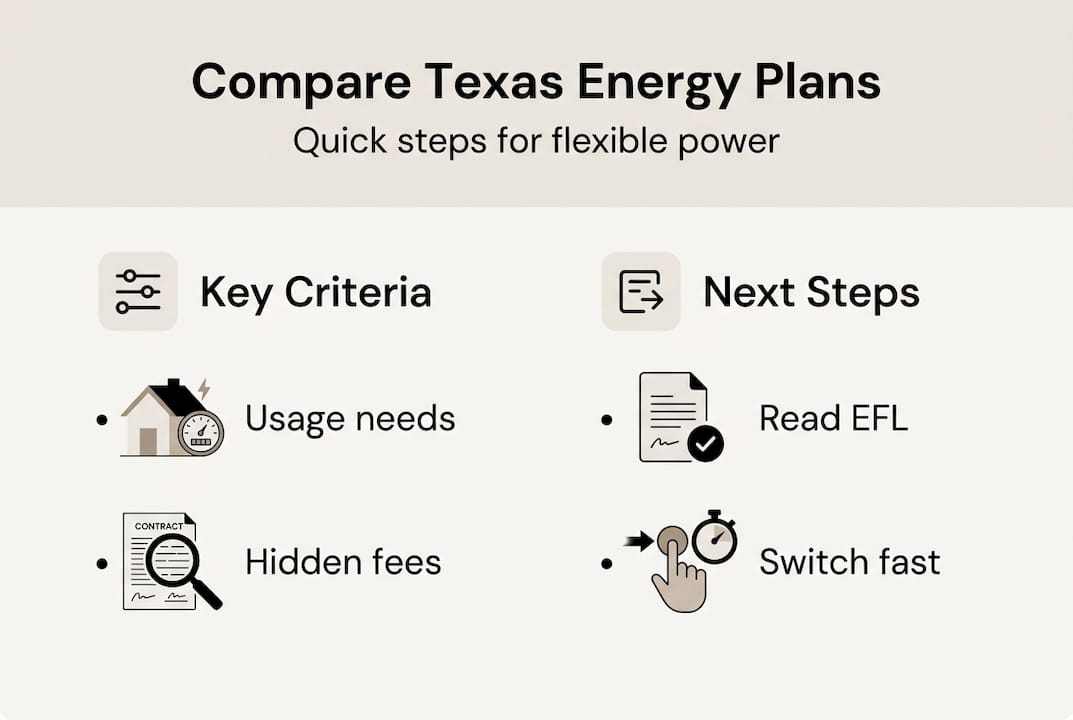
Online platforms now make plan comparison and switching easier than ever, and there are several certified tools that pull live rate data from multiple providers at once. Using best alternative comparison sites rather than going directly to a single provider’s website gives you a broader view and reduces the chance of missing a better deal.
Here’s how to find a trustworthy plan:
- Use certified comparison platforms that show full EFL details, not just teaser rates.
- Filter results by no-deposit or prepaid options if that’s your priority.
- Confirm the provider is licensed by the Public Utility Commission of Texas (PUCT).
- Read at least three customer reviews from verified users.
- Verify the activation timeline before completing signup.
Switching to a prepaid plan can be a smart choice for those with limited credit or immediate needs, and the switch itself is simpler than most people expect. The new provider handles most of the process on your behalf.
How to go from research to power-on in under 24 hours:
- Gather your address and, if available, your current account number.
- Visit a certified comparison platform and filter for same-day or prepaid plans.
- Read the EFL for your top two choices.
- Select your plan and complete the online signup, takes about 10 minutes.
- Confirm your activation date and check for a confirmation email.
- If you’re on a prepaid plan, load your first balance immediately to avoid service delays.
“Many prepaid and no-deposit plans activate within hours of signup, giving Texas residents a real advantage when time matters.”
You can also explore prepaid electricity providers directly to find options already filtered for no-deposit and same-day service.
Why most Texas energy plan comparisons fall short
Most guides, including the ones plastered across energy comparison sites, focus almost entirely on the rate per kWh. That single number gets treated like the final answer. It isn’t.
Here’s the uncomfortable truth: a plan with a lower rate and a $150 early termination fee, a $15 minimum usage charge, and a two-day activation delay can easily cost more than a prepaid option with a slightly higher kWh rate and zero fees. The math only makes sense when you look at the whole picture, not just the headline.
For Texans facing urgency or credit challenges, the biggest pitfall isn’t picking the wrong rate. It’s ignoring the variables that matter most: speed of service, deposit requirements, and the real-world weight of contract traps. We’ve seen customers sign up for a plan that looks great on a comparison chart, only to discover they can’t afford the upfront deposit or can’t get service activated until next week.
The plan that truly saves you money is the one that fits your actual life. That means your usage patterns, your timeline, your credit situation, and yes, your ability to absorb unexpected fees. You can manage costs flexibly by choosing a plan structure that matches your reality, not just the one with the most appealing number on a comparison table.
Pro Tip: Always verify switch times and no-deposit guarantees before you finalize a plan. Ask the provider directly: “How long until my service is active?” A trustworthy provider will give you a clear answer.
Get started with fast, flexible energy plans today
If you’re ready to move forward, here’s how you can secure the right plan and get your lights on faster. Everything covered in this guide points toward one key move: choosing a plan built around your needs, not just a number on a rate chart.

Same Day Electricity specializes in no-deposit power options designed for Texas residents who need fast, flexible service without the credit check or upfront deposit. Whether you’re setting up same day power in Texas or looking for electricity with no credit check, the platform walks you through each step clearly. No hidden fees, no confusing contracts, and no waiting around. Start your comparison today and see how quickly you can get activated.
Frequently asked questions
What documents do I need to switch to a new Texas energy provider?
Typically, you need proof of address and a valid ID, but many prepaid plans require minimal paperwork and skip the credit check entirely.
How fast can I get electricity turned on in Texas?
You can often get electricity activated the same day if you choose a provider offering same-day or prepaid services, since quick activation is possible through many REPs in the deregulated market.
What is the difference between fixed and variable rate energy plans in Texas?
A fixed plan locks in your rate for the full contract term, while a variable rate plan can change month to month based on market conditions.
Can I compare Texas energy plans online safely?
Yes, using certified comparison platforms and reviewing each plan’s EFL is the safest approach, since online plan comparison tools now pull live data from licensed Texas providers.