

TL;DR:
- Texas offers prepaid and pay-as-you-go electricity plans that require no credit check or deposit.
- Upfront payment of $40–$75 provides immediate service, but service ends instantly when balance reaches zero.
- Active account monitoring and pre-planning are essential to avoid disconnection risks in prepaid plans.
Moving into a new place in Texas with poor or no credit feels like hitting a wall before you even flip a light switch. Traditional utility providers pull your credit and demand deposits that can run hundreds of dollars, which you may not have. Here’s the good news: Texas’s deregulated energy market gives you real alternatives. Prepaid plans and deposit waivers let you skip the credit check entirely and get power flowing, sometimes on the very same day you sign up. This guide walks you through every step so you can stop worrying and start living with the lights on.
Table of Contents
- Understanding your options: Electricity with no credit or deposit
- What you need before starting: Tools, documents, and requirements
- Step-by-step: How to get electricity with no credit
- Avoiding common pitfalls and maximizing your plan
- A smarter energy start: What most people miss
- Get electricity today — No credit, no deposit, no hassle
- Frequently asked questions
Key Takeaways
| Point | Details |
|---|---|
| Prepaid plans available | You can get electricity in Texas with no credit check using prepaid plans. |
| Low upfront cost | Most plans require only a $40-$75 start balance instead of a large deposit. |
| Fast connection | Same-day power is possible when you sign up and pay before cutoff times. |
| Monitor account closely | Keep an eye on your balance since service can stop immediately if it runs out. |
| Know your protections | Certain Texans can skip deposits due to state rules and assistance programs. |
Understanding your options: Electricity with no credit or deposit
Texas deregulates its electricity market, meaning private providers compete for your business instead of one company holding all the cards. That competition created a category of plans built specifically for people who can’t or won’t submit to a credit check: prepaid and pay-as-you-go electricity.
The best choice for bad credit in most cases is a prepaid plan. With these plans, no deposit electricity is the standard because providers like Payless Power, Pogo Energy, and Acacia Energy operate entirely on a prepay model. You load money onto your account before you use electricity, the same way a prepaid phone works.
Texas Public Utility Commission (PUC) rules also give certain groups a mandatory deposit waiver on standard postpaid plans. These groups include:
- Seniors age 65 and older
- Customers enrolled in assistance programs such as SNAP or Medicaid
- Active duty military members in some cases
- Customers with a co-signer who has good credit
For everyone else who does not qualify for a waiver, the prepaid route is the fastest path. Under PUC rules 25.24 and 25.498, prepaid providers cannot require a traditional deposit. Instead, you pay a starting connection balance that typically runs between $40 and $75.
Here is a side-by-side look at your main options:
| Plan type | Credit check | Deposit required | Starting cost | Disconnect risk |
|---|---|---|---|---|
| Prepaid/pay-as-you-go | No | No | $40–$75 balance | Immediate if balance hits $0 |
| Postpaid with deposit waiver | Yes (waived) | No | Standard fees | Standard grace period |
| Standard postpaid | Yes | Yes ($100–$300+) | Deposit + fees | Grace period applies |
The critical trade-off with prepaid is speed versus safety net. The no deposit electricity benefits are real, but under state rules your service can be cut off immediately when your balance hits zero. There is no grace period. Monitoring your account daily is not optional; it is essential.
What you need before starting: Tools, documents, and requirements
With your plan chosen, gather what you will need for a simple sign-up. Getting organized before you start the application saves time and prevents frustrating delays.
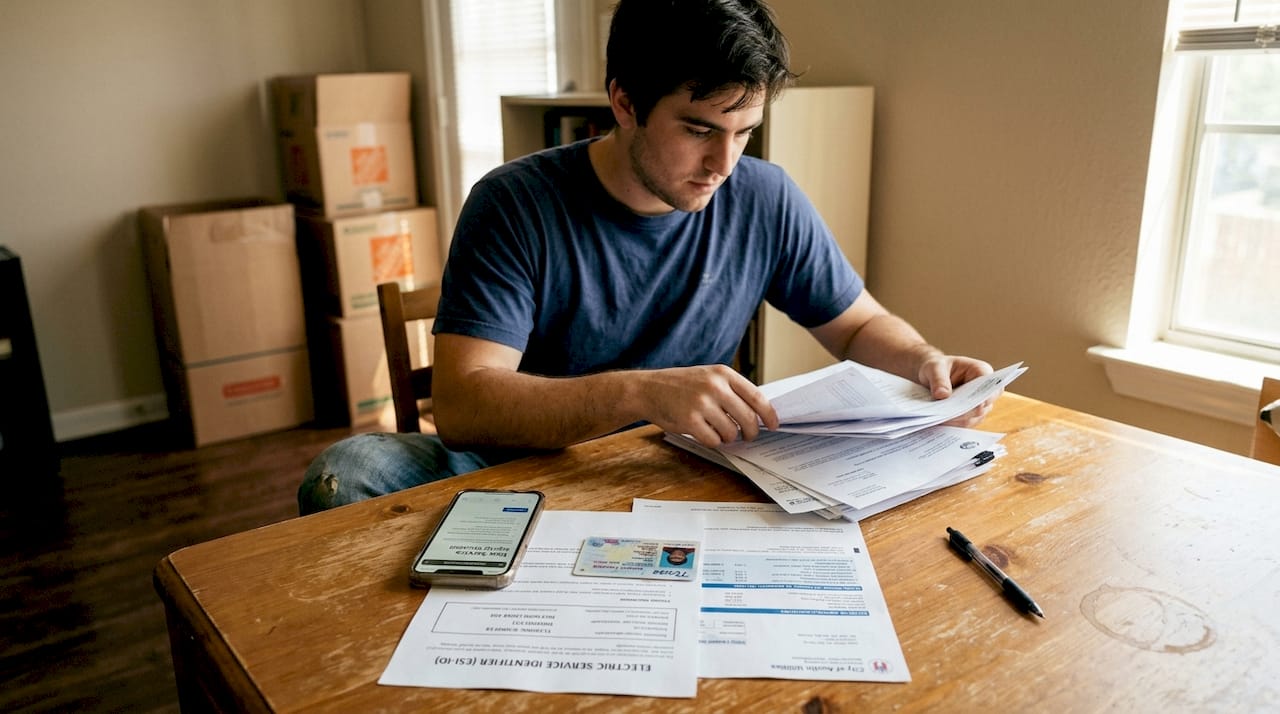
First, confirm your address is in a deregulated service area. Most Texas cities fall under deregulation, including Houston, Dallas, Fort Worth, and Corpus Christi. However, Austin, San Antonio, and El Paso use municipally owned utilities and are not deregulated. You can use the plan comparison tool or the Power to Choose website to check your specific address.
Next, locate your home’s ESI-ID (Electric Service Identifier). This is a unique number tied to your meter at that address, not to you personally. Your ESI-ID appears on any previous electric bill at that address, or you can ask your landlord. Having it ready speeds up the enrollment process considerably.
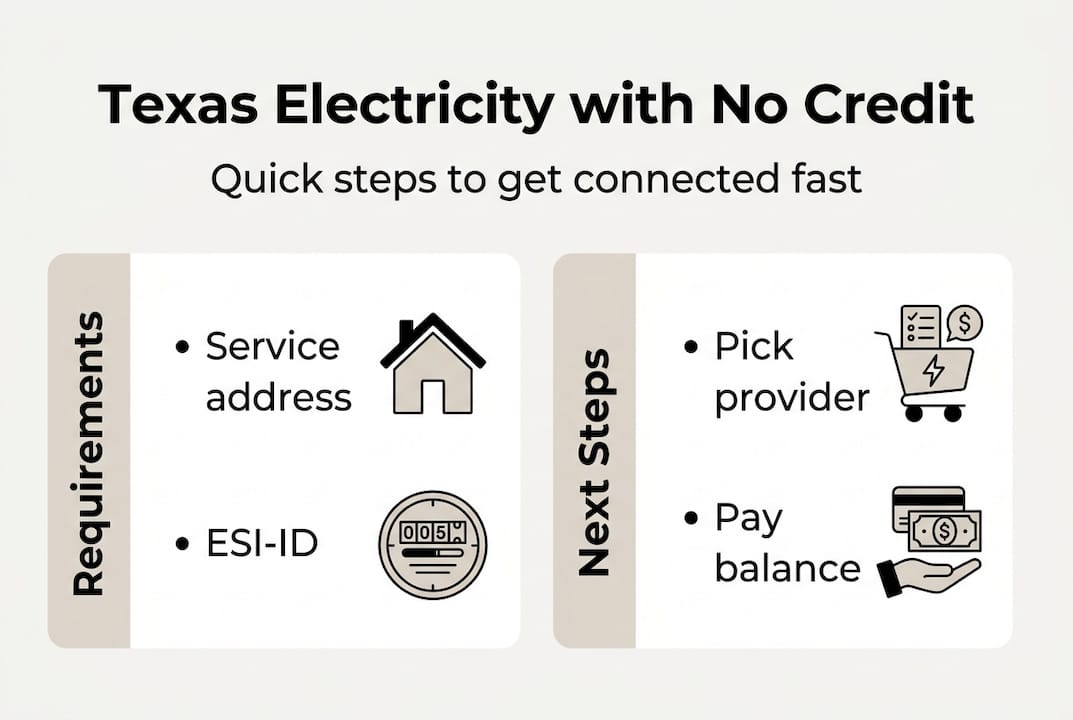
Here is a quick reference for what most prepaid providers will ask for:
| Requirement | Notes |
|---|---|
| Service address | Must be in a deregulated area |
| ESI-ID | Found on previous bills or from landlord |
| Government-issued ID | Driver’s license, passport, or state ID |
| Social Security Number | Often not required for prepaid plans |
| Payment method | Credit card, debit card, or cash reload |
| Starting balance | Usually $40–$75 |
According to the enrollment process overview, prepaid providers often skip the SSN requirement entirely, which removes a major barrier for people who are new to the country or prefer not to share that information.
Pro Tip: Call or chat with your chosen provider before signing up to confirm exactly what ID they accept. Some prepaid companies accept a Matricula Consular card or foreign passport, which opens the door for many residents who lack a U.S. driver’s license.
Also review the PUC prepaid rules before you commit to any plan. Understanding what protections apply to you helps you ask better questions and spot any provider that is not playing by the rules.
For residents in smaller Texas cities, a localized prepaid setup guide can show you exactly which providers serve your area and what their specific starting balance requirements look like.
Step-by-step: How to get electricity with no credit
With everything prepared, here is exactly how to get electricity with no credit.
Step 1: Confirm your address is in a deregulated area. Go to Power to Choose (powertochoose.org) and enter your zip code. If results appear, you are in a deregulated market. Major non-deregulated cities like Austin and San Antonio will not show retail provider options.
Step 2: Gather your ESI-ID and identification. Pull the ESI-ID from a previous bill at that address or ask your landlord. Have your ID ready. For most prepaid plans, this is all you need.
Step 3: Pick a prepaid provider or apply for a deposit waiver. Compare rates, fees, and balance alert features. Check whether the provider sends low-balance texts, because that feature alone prevents most disconnections.
Step 4: Complete the online or phone application. The electricity set-up guide walks through this in detail. Most applications take under 10 minutes. Enter your service address, ESI-ID, and contact information.
Step 5: Pay your starting balance of $40–$75. Per the same-day enrollment process, this is a service balance, not a deposit, meaning it goes toward your actual electricity use, not a security hold.
Step 6: Request same-day service if needed. Same-day activation is usually available on weekdays if you apply before the provider’s daily cutoff, often around 4 to 5 PM. If you miss the cutoff, next-business-day activation is standard.
Step 7: Set up account alerts. Log into your new account and turn on low-balance text or email notifications. Set your alert threshold above $20 so you have time to reload before service interrupts.
Important warning: Prepaid electricity in Texas has no grace period. If your balance drops to $0 on a 100-degree August afternoon, your power shuts off immediately. Always maintain a cushion in your account, especially heading into summer. Never assume you have more time than your current balance allows.
For residents in coastal Texas, reviewing Palacios prepaid options can help you find local providers with competitive rates in your specific market.
Avoiding common pitfalls and maximizing your plan
Finally, stay connected and get the most from your new plan with these practical tips.
The biggest mistake prepaid customers make is checking their balance only when something feels wrong. By then, the disconnect has often already happened. Build a habit of checking your balance every morning the same way you check the weather.
The PUCT protections for prepaid customers are more limited than those for postpaid customers. For example, postpaid customers get multiple disconnect notices and grace periods. Prepaid customers get low-balance alerts only if the provider offers them, which is why you must confirm that feature before choosing your plan.
Here are the most important habits to protect your service and manage costs:
- Read your Electricity Facts Label (EFL) before signing up. The EFL shows the true cost per kilowatt-hour at different usage levels (500, 1,000, and 2,000 kWh). A rate that looks cheap at 2,000 kWh may be much higher at 500 kWh, which is common in smaller homes or apartments.
- Set auto-reload or calendar reminders to add funds before weekends or holidays when customer service may be slower.
- Shift high-energy tasks like laundry, dishwashing, and charging devices to off-peak hours, typically evenings after 9 PM, when usage costs may be lower.
- Check your summer bill expectations by reviewing affordable prepaid tips before the heat hits, because summer usage in Texas can triple your normal monthly cost.
- Avoid the most common mistakes by reviewing common prepaid pitfalls before your first billing cycle.
Pro Tip: The EFL is a legal document that every Texas provider must supply. If a provider won’t show you the EFL before you sign up, walk away. Transparency is a minimum standard, not a bonus feature.
As noted in the PUC prepaid FAQ, always review the EFL for total cost at 1,000 kWh. Prepaid suits low-usage or variable needs well, but the shutoff risk during extreme heat is a real concern that demands active management.
A smarter energy start: What most people miss
Here is something the broader conversation about no-credit electricity rarely acknowledges: prepaid is not just a fallback for people in financial trouble. For renters who move frequently, seasonal workers, or anyone who wants strict control over monthly spending, a prepaid plan is genuinely a smarter structure than a postpaid bill that surprises you at month’s end.
That said, the prepaid pitfalls advice we have seen play out repeatedly in Texas energy markets comes down to one root cause: people treat prepaid like postpaid. They sign up, forget about it, and then get hit with a sudden shutoff on the hottest day of the year. The Texas heat is not forgiving.
The real opportunity here is to use prepaid as a budgeting tool, not just a credit workaround. When you load a fixed amount each week, your electricity cost becomes predictable and visible. That visibility changes how you use energy. Most customers who actively monitor their balance naturally reduce usage by 10 to 15 percent within the first two months without any deliberate conservation effort. Awareness alone changes behavior.
Read the EFL every single time you switch plans or renew. Rates change, and a plan that was competitive last summer may not be this summer.
Get electricity today — No credit, no deposit, no hassle
If you are ready to stop letting a credit score stand between you and a powered home, Same Day Electricity makes the process straightforward.

We connect Texas residents to prepaid and no-deposit electricity plans with no credit check required. Whether you need electricity with no credit today or want to compare your options first, we have you covered. Our service areas span the major deregulated Texas markets, and same-day activation is available on qualifying plans. For fast, flexible electricity that fits your budget and your timeline, visit Same Day Electricity and get your lights on today.
Frequently asked questions
Can I get electricity in Texas without a credit check?
Yes, prepaid plans require no credit check or deposit in Texas deregulated markets, just an initial starting balance to activate service.
Is a deposit always required to get electricity in Texas?
No, PUC rules mandate waivers for seniors 65 and older, customers on qualifying assistance programs, and other eligible groups, and prepaid plans replace deposits with a small starting balance.
How soon can I get connected after signing up for a no-credit prepaid plan?
Most providers offer same-day connection if you complete enrollment and pay your starting balance before the daily cutoff, typically around 4 to 5 PM on weekdays.
What happens if my prepaid electricity balance runs out?
Under Texas prepaid rules, your electricity can be disconnected immediately when your balance hits $0 with no grace period, so daily balance monitoring is critical.