

TL;DR:
- Texas offers no-deposit prepaid and deposit waiver options for residents with poor or no credit.
- Prepaid plans enable same-day activation without credit checks or paperwork delays.
- Gathering qualifying documents early is essential for deposit waivers and quick service activation.
Getting electricity turned on when you have poor or no credit can feel like hitting a wall right when you need power most. A hefty deposit demand from a provider, a failed credit check, or confusing paperwork can delay your service for days. The good news is that Texas law gives you real options, including no-deposit prepaid plans you can activate the same day, plus formal deposit waiver pathways if you qualify. This guide walks you through every step, from understanding the rules to picking a plan and getting your lights on fast, without letting your credit score decide whether you can keep the heat running.
Table of Contents
- Understanding Texas electricity deposit and credit rules
- Enrollment options for poor or no credit: postpaid vs. prepaid service
- Preparing your documents and eligibility for deposit waivers
- How to enroll and activate electricity service fast
- The truth about Texas electricity enrollment barriers
- Unlock affordable, same-day Texas electricity—your next steps
- Frequently asked questions
Key Takeaways
| Point | Details |
|---|---|
| Deposit requirements explained | Texas law sets specific deposit and credit rules for electricity enrollment, which may block many residents. |
| Prepaid plans enable access | Prepaid electricity in Texas lets you enroll fast without deposits or credit checks. |
| Deposit waivers for qualifying residents | You can get a deposit waived if you meet criteria such as age, payment history, disability, or provide family violence certification. |
| Speed up same-day activation | Prepare eligibility documents in advance to avoid delays and secure immediate power. |
| Options beyond credit barriers | Knowing all regulated pathways gives you more choices and lowers your costs regardless of your credit. |
Understanding Texas electricity deposit and credit rules
Texas runs a deregulated electricity market, which means you choose your own retail electric provider (REP). That freedom is valuable, but it also means each provider can set its own credit and deposit policies within limits established by state regulators.
The PUCT credit and deposit rules are laid out in the Public Utility Commission of Texas (PUCT) Substantive Rule 25.24. This rule governs when providers can require a deposit, how large that deposit can be, and what your rights are as a customer. Under these rules, a provider can check your credit and request a deposit based on your credit score, past service history, or payment record.
What the deposit rules actually mean for you
Here is what typically happens when you apply for postpaid electricity service as a new customer with poor credit:
- Credit check triggered: The provider pulls your credit report or checks a utility credit database.
- Deposit calculated: If your score falls below the provider’s threshold, they can require a deposit, typically up to the estimated cost of two months of service.
- Deposit paid upfront: You pay before service starts, which can range from $100 to $300 or more depending on your usage area and plan.
- Service delayed: If you cannot pay immediately, activation stalls.
This process can completely block same-day service for residents without savings to cover a deposit. That is exactly why knowing your alternatives matters before you even start shopping.
Who qualifies for a deposit waiver?
Texas rules also define specific categories of customers who can request a waiver of the deposit requirement. Under PUCT Rule 25.24, these waivers are available for:
| Qualifying category | Documentation typically required |
|---|---|
| Age 65 or older | Government-issued ID showing birthdate |
| Good payment history (12+ months, same provider) | Account history letter from prior provider |
| Disability or receiving public assistance | Benefit award letter (SSI, Medicaid, SNAP) |
| Family violence victim | Certification letter from approved organization |
Important: A waiver is not guaranteed just because you qualify on paper. You must present acceptable documentation, and each provider processes waivers differently. Start gathering your documents before you apply.
If you do not fit any of these waiver categories and cannot pay a deposit, your fastest path to power is a prepaid plan. You can get no-credit electricity fast through providers that do not run credit checks at all.
Enrollment options for poor or no credit: postpaid vs. prepaid service
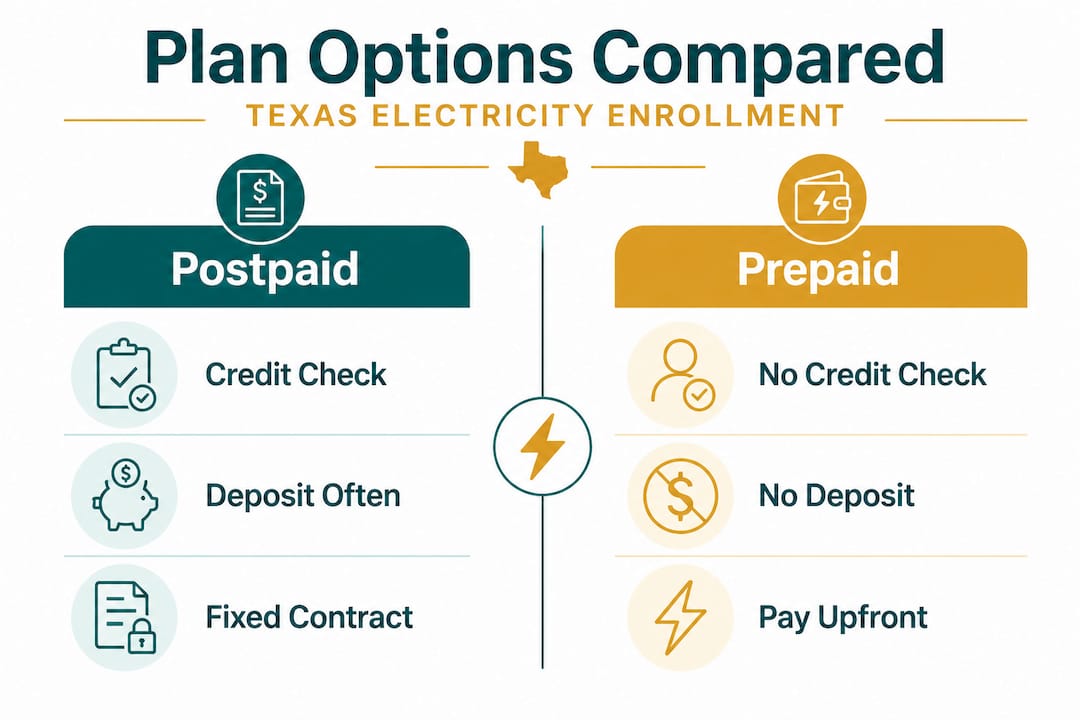
Now that you know the deposit rules, it is time to explore your enrollment options. Broadly, you have two paths: postpaid service (standard monthly billing with a credit check and possible deposit) and prepaid service (pay-as-you-go with no deposit required).
Postpaid plans
Postpaid plans bill you at the end of each month based on actual usage. They often come with fixed rates and contract terms, which can be great for budgeting if you qualify. The problem is the upfront deposit requirement for anyone with poor or no credit. Even with a waiver, the paperwork process adds time, meaning same-day activation is harder to guarantee.
Prepaid plans: the no-deposit solution
Prepaid electricity in Texas operates under a separate regulatory framework. PUCT §25.498 defines the rules for prepaid service providers, including required disclosures, notice requirements when your balance runs low, and customer protections. This regulated framework means you are not stepping into the wild west. You have real rights and consumer protections even on a prepaid plan.
Here is a direct comparison to help you decide:
| Feature | Postpaid plan | Prepaid plan |
|---|---|---|
| Credit check | Yes | No |
| Deposit required | Often yes (unless waived) | No |
| Same-day activation | Possible, but uncertain | Very common |
| Billing | Monthly after usage | Pay in advance |
| Contract required | Often | Rarely |
| Shut-off risk | Non-payment (30+ days) | Low balance triggers notice |
| Best for | Stable credit, budget certainty | Poor/no credit, fast activation |
Pro Tip: If you want to eventually switch to a postpaid plan with better rates, start with prepaid to establish a payment track record. Some providers offer loyalty pathways that waive deposit requirements after 12 months of clean payment history.
How to choose the right pathway
Follow this simple decision process:
- Check your waiver eligibility first. If you are 65+, receive disability assistance, or are a family violence victim with certification, you may qualify for a postpaid plan without a deposit.
- If you do not qualify for a waiver, go prepaid. No paperwork delays, no deposit, and activation happens fast.
- Compare plans before committing. Different prepaid providers offer different rates and features. Compare pay-as-you-go plans to find the best rate for your zip code.
- Look at flexible payment structures. Some plans let you load small amounts daily or weekly, which works well when cash flow is tight.
The right choice depends on your timeline and documents available. For most poor or no-credit residents who need power today, bad credit prepaid electricity is the fastest and least complicated route.
Preparing your documents and eligibility for deposit waivers
With plan types clear, let us get your paperwork ready for any deposit waivers. Even if you plan to go prepaid, it is worth understanding your waiver options in case you want to upgrade to postpaid service later.
The PUCT consumer assistance page details formal help routes for bill affordability, including deposit waiver eligibility for family violence victims who obtain a certification letter from the Texas Council on Family Violence. This is an often-missed resource that can open doors to standard postpaid service for people who assume they have no options.
Document checklist by waiver category
Age-based waiver (65+):
- Government-issued photo ID (driver’s license, state ID, passport)
- Social Security card or Medicare card to confirm identity
Payment history waiver:
- Letter from your previous Texas REP confirming 12+ months of on-time payments
- Account number and service address from previous service
Disability or public assistance waiver:
- Award letter from SSI, SSDI, Medicaid, SNAP, CHIP, or similar program
- The letter must be current (usually within the last 12 months)
Family violence victim waiver:
- Certification letter issued by an approved agency, such as a local domestic violence shelter or legal aid organization affiliated with the Texas Council on Family Violence
- The certification confirms your status without requiring you to disclose personal details directly to the utility provider
Pro Tip: Request your certification letter in advance if you think you may qualify under the family violence category. These letters take time to obtain, and having one ready gives you immediate access to postpaid service without a deposit the moment you apply.
Where to get your documents fast
- Social service offices: Your local Health and Human Services (HHS) office can print benefit award letters on the same day in many counties.
- Previous utility provider: Call and request a payment history letter. Many providers send these digitally within 24 to 48 hours.
- Family violence shelters: If you are working with a shelter or advocacy organization, ask their case manager directly about the certification process.
Having these documents ready cuts your enrollment time dramatically. If you are going prepaid, you do not need any of this, which is exactly why flexible payment options are so popular among residents who need power without the wait.
How to enroll and activate electricity service fast
With your eligibility proofs ready, it is time to enroll and activate your power service. The process differs slightly depending on whether you choose prepaid or postpaid with a deposit waiver, but the core steps are similar.
Step-by-step enrollment process
- Confirm your utility area. Texas deregulation applies to areas served by Oncor, CenterPoint, AEP, and other transmission utilities. Enter your zip code on any provider’s site to confirm you are in a competitive market.
- Select your plan type. Based on your waiver eligibility, choose prepaid (fastest, no paperwork) or postpaid with waiver documentation ready.
- Gather your account details. You will need your service address, a valid email, a phone number, and your ESI ID (Electric Service Identifier). Your ESI ID is a unique number tied to your address’s meter, and you can find it on a prior bill or by calling your utility directly.
- Complete the online application. Most prepaid providers have a 10 to 15 minute enrollment process. Fill in your address, choose your plan, and submit payment to load your prepaid balance.
- Submit deposit waiver documents (postpaid only). Upload or email your qualifying documents. The provider reviews them and confirms your deposit-free status before activating service.
- Confirm your start date. For prepaid, activation typically happens the same day. For postpaid with waivers, confirm the exact start time with the provider.
- Verify service. Check that your meter reads correctly and that your online account shows active service.
Watch out for this common mistake: Many applicants enter an incorrect ESI ID or service address, which triggers an error and delays activation by 24 to 48 hours. Double-check this number before submitting your application.
Understanding the factors that affect your prepaid bill helps you load the right amount upfront and avoid a low-balance disconnection in the first week. Your usage will vary with season, home size, and appliance efficiency, so starting with a buffer balance is smart.
You can review top prepaid providers to compare rates and features in your area before making a final choice. Rates vary between providers, and even a fraction of a cent per kilowatt-hour difference adds up over a Texas summer.
Pro Tip: If you live in Killeen or the surrounding area, check out Killeen prepaid electricity options that serve that specific utility zone. Local plan availability changes by territory, so always verify with your zip code.
Under PUCT Rule 25.24, deposit waivers under PUCT rules can allow access to traditional postpaid fixed or variable plans without the full security deposit, but they require qualifying circumstances and documentation. That is a powerful option that most applicants never use simply because they did not know it existed.
The truth about Texas electricity enrollment barriers
Here is something most electricity guides will not tell you: the biggest barrier to affordable power for poor or no-credit residents is not the rules themselves. It is the lack of clear information about what those rules actually allow.
The PUCT deposit and credit framework is actually more generous than most people realize. PUCT Rule 25.24 protects customers in multiple ways, from capping deposit amounts to requiring providers to pay interest on held deposits. But if you walk into enrollment not knowing these protections exist, you accept the first answer a provider gives you, even if that answer is not your only option.
The family violence deposit waiver is a perfect example. Thousands of Texans who qualify for this waiver never use it because they either do not know it exists or feel too intimidated to ask. The certification process takes effort, but the result is access to standard postpaid service with competitive rates, zero deposit, and full consumer protections.
Another overlooked reality: prepaid electricity is not a lesser product. It is a fully regulated, consumer-protected service option under Texas law. For residents who need power immediately and cannot wait for waiver paperwork, exploring flexibility through prepaid is not a compromise. It is a smart, legal, and often more transparent way to manage your energy costs.
The system can feel designed to push poor or no-credit residents toward higher-cost options or worse, toward living without power. But knowing your rights and your full range of options flips that equation. You have more leverage than you think.
Unlock affordable, same-day Texas electricity—your next steps
You have learned the rules, the pathways, and the exact steps to enroll. Now it is time to put that knowledge into action and get your power on without delays or deposit surprises.

Same Day Electricity makes it simple to activate affordable, no-deposit electricity service across Texas, often within the same day. Whether you are in Houston, Dallas, San Antonio, or a smaller city like Killeen, our prepaid plans connect you to your local utility grid with no credit check, no deposit, and no contracts. You load what you need, track your usage in real time, and stay in control of your energy costs every single month. Compare your options, pick the plan that fits your budget, and activate service today without the stress.
Frequently asked questions
Can I get electricity in Texas with bad credit and no deposit?
Yes. PUCT §25.498 governs regulated prepaid service in Texas, which requires no deposit and no credit check, and deposit waivers under Rule 25.24 are available for qualifying situations like age, disability, or family violence certification.
What situations qualify for deposit waivers on Texas electricity?
PUCT consumer assistance resources confirm that deposit waivers are available for residents aged 65 or older, those with 12 months of qualifying payment history, disability or public assistance recipients, and certified family violence victims.
How fast can I activate prepaid electricity service in Texas?
Under PUCT §25.498, prepaid service providers operate under specific regulatory requirements that support fast enrollment, and most customers can activate service the same day once their application and initial payment are submitted online.
What documents do I need for a deposit waiver?
Per PUCT consumer assistance guidelines, you will need proof of your qualifying status, which may include a government-issued ID for age, a benefit award letter for disability or assistance, a payment history letter for 12-month track record, or a certification letter from an approved organization for family violence victims.