

TL;DR:
- Texas deregulation allows consumers to choose their electricity providers, promoting competition and lower rates.
- Prepaid plans require no deposit, no credit check, but disconnect immediately at zero balance.
- Understanding the Electricity Facts Label and legal protections helps consumers compare plans and avoid surprises.
Most Texas residents assume the state controls what they pay for electricity. That assumption costs them money. Texas deregulated its electricity market through Senate Bill 7 in 1999, with full implementation by 2002, giving roughly 85% of Texans the legal right to pick their own retail electric provider. That means you have real options, real protections, and real tools to find affordable power without handing over a deposit. This guide breaks down what Texas energy law actually says, what rights it gives you, and how to use those rights to secure the best plan for your situation.
Table of Contents
- How Texas energy law puts you in control
- Understanding your rights: Key rules for deposits, prepaid, and billing
- How to compare Texas electricity plans: Know your numbers, use your rights
- The pros and cons of Texas energy deregulation
- Our perspective: What most guides miss about Texas energy law
- Ready to put Texas energy law to work for you?
- Frequently asked questions
Key Takeaways
| Point | Details |
|---|---|
| Deregulation enables choice | Most Texans can choose their own electricity provider thanks to state laws. |
| Strong consumer protections | PUC rules guard your rights on deposits, billing, and plan terms. |
| No-deposit options exist | Prepaid electricity plans in Texas don’t require deposits or credit checks. |
| Educate before you enroll | Always check Electricity Facts Labels to know the real cost of any plan. |
How Texas energy law puts you in control
Texas energy law is not just a bureaucratic framework. It is the reason you can switch electricity providers without moving, find plans that match your budget, and avoid deposits entirely if you know where to look.
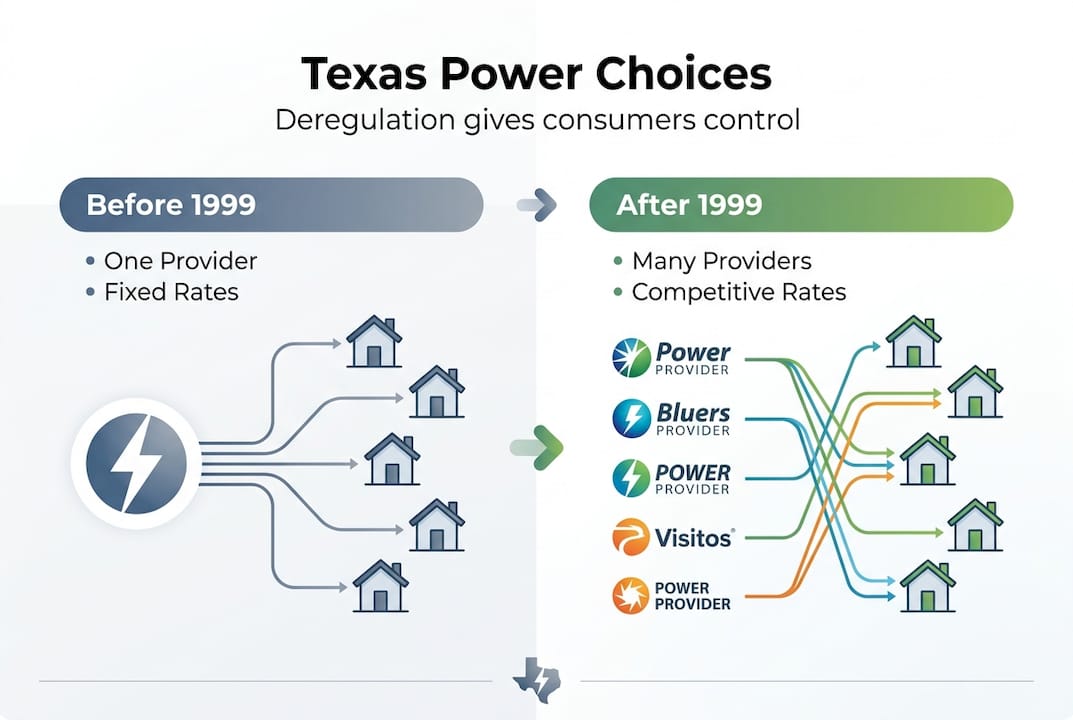
The foundation is deregulation. Before 1999, a single utility in each region controlled generation, transmission, and retail sales. Senate Bill 7 broke that model apart. Today, about 85% of Texas falls under the Electric Reliability Council of Texas (ERCOT), where retail competition is fully open. That means dozens of Retail Electric Providers (REPs) compete for your business, which drives down prices and pushes providers to offer creative, flexible plans.
The Public Utility Commission of Texas (PUCT) is the state agency that keeps this market honest. Under Chapter 25 rules, the PUCT licenses every REP, sets standards for billing accuracy, governs how and when providers can disconnect service, and limits what they can charge for deposits. Without the PUCT, deregulation would be a free-for-all. With it, you have legally enforceable rights every time you sign up for a plan.
Here is what deregulation means in practical terms for most Texas households:
- You can switch REPs whenever a contract ends, or sometimes earlier with no penalty on month-to-month plans
- Providers must compete on price, plan features, and service quality to earn your business
- You can find affordable power plans ranging from fixed-rate contracts to flexible prepaid accounts
- You can start service quickly, often on the same day, because the process is designed to be competitive and accessible
Not every Texan has this freedom. Residents in Austin (served by Austin Energy) and San Antonio (served by CPS Energy) live in municipally owned utility territories where retail choice does not exist. Residents in areas served by El Paso Electric face a similar situation, as that market is not under ERCOT. If you live in these cities, your rate is set by the utility, full stop. But if you live in Houston, Dallas, Fort Worth, Midland, Waco, or most other Texas metro areas, competition is fully active and the electricity sign-up process is straightforward.
Texas deregulation brings genuine benefits: lower rates, faster innovation, and flexible plan options. The occasional drawback is complexity. Knowing your rights flips that complexity in your favor.
The key takeaway is simple. Deregulation hands you a tool. Texas law protects how you use it. The next step is understanding exactly which protections apply to your situation.
Understanding your rights: Key rules for deposits, prepaid, and billing
With the basics of Texas energy law clear, let’s highlight the specific protections and options you have as a consumer. These are not vague suggestions. They are codified rules that every licensed REP must follow.
Chapter 25 of the PUCT rules covers deposit limits, billing accuracy, disconnection procedures, and more. Under traditional postpaid plans, providers can require a deposit, but the deposit is capped based on estimated usage, and they must pay interest on it. They must give advance notice before disconnecting service. They cannot disconnect during extreme heat or cold events without following specific procedures. These protections matter, and most customers never realize they have them until something goes wrong.
Prepaid electricity operates under a separate section of Chapter 25, specifically §25.498. Here is how prepaid works under Texas law:
- No deposit required. Providers cannot ask you to pay a deposit upfront when you choose a prepaid plan.
- No credit check. Your credit score is not a factor. Anyone can qualify.
- Balance alerts are required. Your provider must notify you when your balance drops below a set threshold, giving you a chance to add funds.
- Disconnect at zero. If your balance reaches zero, service can be cut off immediately, without the advance notice required for postpaid plans.
That last point is the one that catches people off guard. With a traditional plan, disconnection requires days of notice. With prepaid, the protection is the alert system, not a waiting period. The law requires alerts, not a grace period after your balance hits zero.
| Feature | Traditional postpaid plan | Prepaid plan |
|---|---|---|
| Deposit required | Often yes, varies by credit | No |
| Credit check | Yes | No |
| Disconnect notice required | Yes, advance notice | Not after zero balance |
| Balance alerts | Not applicable | Required by law |
| Billing cycle | Monthly | As you go |
| Sign-up speed | 1 to 3 days | Same day possible |
This table shows why prepaid plans are especially useful if you have no credit history, poor credit, or simply want to avoid the deposit process entirely. You can explore no credit check options that fit squarely within PUCT rules and still give you full residential electricity service.
The best way to use no-deposit plans is to treat them like a debit card for your home’s power. Add funds regularly, watch your alerts, and you will never face an unexpected disconnect. If you want more detail on managing your usage and costs, prepaid plan tips can help you stretch every dollar further.

Pro Tip: Keep your prepaid balance above the alert threshold at all times, especially during summer when air conditioning can drain your balance faster than expected. Setting a calendar reminder to add funds each week removes the risk of waking up to no power.
How to compare Texas electricity plans: Know your numbers, use your rights
Armed with consumer protections, the next step is making smart choices. Here is how the law ensures transparency when picking your plan, and how to use those tools effectively.
Every licensed REP in Texas must provide an Electricity Facts Label, commonly called an EFL, for every plan they offer. The EFL is not marketing material. It is a legally required disclosure document that shows the actual average price per kilowatt-hour (kWh) at three usage levels: 500 kWh, 1,000 kWh, and 2,000 kWh per month. This matters because many plans have base charges, minimum usage fees, or tiered pricing that make the “advertised rate” meaningless without context.
The EFL and Power to Choose system work together to give you a clear, standardized way to compare plans. Power to Choose at powertochoose.org is the only PUCT-sanctioned comparison website. It pulls EFL data from all licensed providers so you can filter by ZIP code, contract length, and plan type in one place.
Here is a step-by-step checklist for evaluating any plan before you sign:
- Pull the EFL. Find the actual price per kWh at 1,000 kWh, since that is closest to the average Texas household usage.
- Check for base charges. A monthly flat fee of $9.95 adds about 1 cent per kWh at 1,000 kWh usage. That changes the real rate significantly.
- Look for minimum usage clauses. Some plans charge a fee if you use less than 1,000 kWh in a month. Apartments and small homes often fall below that.
- Verify contract length and cancellation fees. Fixed-rate plans lock in your price but carry early termination fees if you leave early.
- Compare on Power to Choose. Use the official site to stack plans side by side using identical EFL data.
Here is how the same advertised rate can look very different at different usage levels:
| Monthly usage | Advertised rate | Base charge | Actual avg rate |
|---|---|---|---|
| 500 kWh | 11.2 cents/kWh | $9.95 | 13.2 cents/kWh |
| 1,000 kWh | 11.2 cents/kWh | $9.95 | 12.2 cents/kWh |
| 2,000 kWh | 11.2 cents/kWh | $9.95 | 11.7 cents/kWh |
This table illustrates exactly why comparing energy plans by advertised rate alone is a losing game. The EFL removes the guesswork. You can also use the electricity rates guide to understand what a competitive rate looks like in your area before you even start comparing. And if Power to Choose feels limited, there are plan comparison alternatives that offer additional filtering options.
Pro Tip: Always compare plans at the 500 kWh level if you live alone or in a small apartment. Many providers design their pricing to look attractive at 1,000 or 2,000 kWh, which means low-usage customers quietly pay more per kWh than the EFL headline suggests.
The pros and cons of Texas energy deregulation
Before you finalize a plan, it is useful to see both the benefits and the occasional drawbacks of Texas’s deregulated system. The picture is more nuanced than most guides admit.
On the positive side, deregulation has produced real savings for consumers who shop actively. Studies have documented 20 to 40% lower rates compared to what monopoly utility pricing would likely look like. Competition also drives innovation: prepaid plans, green energy options, time-of-use pricing, and smart-home integrations all exist in Texas because providers compete for customers on features, not just price.
The drawbacks are real and worth acknowledging honestly:
- Price volatility. Variable-rate plans can spike dramatically during weather events. The February 2021 winter storm exposed just how dangerous unprotected variable plans can be for households that did not understand their exposure.
- Plan complexity. With dozens of providers and hundreds of plans, the volume of choices can be paralyzing. Many consumers default to whatever is easiest rather than what is best.
- Uneven protection. Customers who do not read the EFL or understand Chapter 25 often pay more than they should and have fewer tools to dispute unexpected charges.
Here is some context that puts Texas electricity in national perspective. Texas rates rank 21st nationally, so the rate per kWh is not the cheapest in the country. However, Texas electricity bills rank 5th highest nationally, driven almost entirely by air conditioning usage during long, hot summers. Residents in regulated cities like Austin and San Antonio pay rates set by their municipal utility with no option to shop elsewhere, which removes both the risk and the opportunity that deregulation brings.
When comparing providers in your area, keep those two facts in mind. A lower rate per kWh matters more in Texas than in most states because your usage is higher. Getting the rate right, whether through a fixed-rate contract or a well-managed prepaid plan, has a larger dollar impact here than it would in a cooler climate.
The bottom line is that deregulation rewards informed consumers. The PUCT has continued updating its rules through 2025 reviews specifically to strengthen consumer protections and address volatility risks. Being informed means the system works for you, not against you.
Our perspective: What most guides miss about Texas energy law
Most Texas electricity guides spend all their time explaining how deregulation works and almost no time explaining what to do with that knowledge the moment you sit down to sign up for a plan.
Here is the reality: knowing your rights under Chapter 25 is not just academic. It is a practical negotiating tool. When a provider gives you a quote that includes a deposit, you can ask about prepaid alternatives and reference your right to navigate the energy choice workflow without paying upfront. When a bill looks wrong, you can file a formal complaint with the PUCT, and licensed providers take those complaints seriously because their REP license depends on compliance.
Too many guides also gloss over what happens at zero balance on a prepaid plan. They mention the benefit (no deposit) without clearly explaining the consequence (immediate disconnect). Being clear-eyed about that dynamic is not a reason to avoid prepaid electricity. It is a reason to manage it proactively. Customers who treat a prepaid balance the way they treat a gas tank, never letting it run to empty, get all the benefits with none of the disruption.
Pro Tip: Before signing any plan, download the EFL and skim the Chapter 25 summary for prepaid or postpaid rules. Five minutes of reading protects you from months of billing surprises.
The consumers who consistently get the best deals in Texas are not the ones who spend hours comparing hundreds of plans. They are the ones who understand two documents: the EFL and their legal rights under Chapter 25. Everything else follows from there.
Ready to put Texas energy law to work for you?
Understanding Texas energy law is only half the equation. Applying it to find affordable, flexible electricity is the other half. You now know your rights, you understand how to read an EFL, and you can identify the plan structure that fits your life.

If avoiding a deposit and skipping the credit check process are your priorities, Same Day Electricity makes it straightforward to act on that knowledge. Explore no deposit electricity options built around PUCT-compliant prepaid plans that let you start service today. If you want a clear walkthrough of the full process, the setup with no credit check guide walks you through activation step by step. Your rights are already in place. Now it is just a matter of using them.
Frequently asked questions
What does Texas energy law mean for my monthly electricity bill?
Texas law lets most residents choose their provider, which creates real competition and the potential for lower rates, but it also means your bill depends on which plan you choose and how much electricity you use. Under Senate Bill 7 deregulation, roughly 85% of Texans have this choice available to them.
Can I get electricity in Texas without a deposit or credit check?
Yes. Prepaid electricity plans are available statewide without a deposit or credit check, and this is guaranteed under §25.498 of PUCT rules, which specifically govern prepaid residential electric service.
How do I compare electricity plans and avoid hidden costs?
Review the Electricity Facts Label for each plan at the 500 and 1,000 kWh usage levels, and use Power to Choose, the official state comparison tool, to see real average prices across all licensed providers in your ZIP code.
What should I know about protections if my balance runs low on a prepaid plan?
Texas law requires your provider to send balance alerts before your account reaches zero, but once it hits zero, §25.498 rules allow immediate disconnection without additional notice, so keeping a buffer in your account is essential.