

TL;DR:
- Confusing electricity terminology in Texas can lead to higher costs and poor plan choices.
- Understanding key terms like TDSP charges, base charges, and plan types helps consumers compare options confidently.
Confusing electricity terminology costs Texans real money every year. When you’re trying to set up a prepaid plan or activate power fast without a deposit, seeing words like “TDSP charge,” “base rate,” or “rate per kWh” without understanding what they mean can lead to picking the wrong plan entirely. This guide cuts through the jargon so you can compare prepaid, no deposit, and no credit check electricity options with confidence. By the time you finish reading, you’ll know exactly what to look for and what to avoid when choosing flexible electricity in Texas.
Table of Contents
- Why electricity terms matter in Texas
- Common electricity plan terms explained
- Comparing plan types: Fixed, variable, and prepaid
- Billing essentials: Fees, rates, and top terms to watch
- The truth most Texans miss about electricity terms
- Fast, flexible electricity options: Get started today
- Frequently asked questions
Key Takeaways
| Point | Details |
|---|---|
| Deregulation means choice | Texas lets you pick your provider, but only if you understand the essential terms. |
| Know the fees | Base charges, TDSP, and late fees can add up—always read the fine print before enrolling. |
| Prepaid equals flexibility | Prepaid plans offer fast setup, no deposit, and no credit check, ideal for quick power needs. |
| Ask before you enroll | Always ask for sample bills and a list of all charges to avoid surprises after activation. |
| Application is power | Using your new understanding helps you save money and avoid pitfalls when signing up for electricity in Texas. |
Why electricity terms matter in Texas
Texas is not like most other states when it comes to electricity. The state runs a deregulated market, which means you get to choose your electricity provider rather than being assigned one. That’s a real advantage. But it also means you’ll encounter more plan types, more billing language, and more marketing terms than residents in regulated states ever deal with.
“Deregulation in Texas allows consumers to choose from among many electricity providers and plan types, making term clarity critical.” — Texas energy law overview
This competitive environment is good for your wallet, but only if you understand what you’re comparing. A plan that advertises 8 cents per kWh might look cheaper than one advertising 10 cents, but if you don’t account for the fixed base charge or TDSP delivery fees layered on top, you could end up paying far more than expected.
For residents looking at prepaid and no deposit options specifically, the stakes are even higher. These plans have unique terms, billing structures, and activation steps that differ from traditional month-to-month contracts. Getting familiar with the vocabulary before you shop means you make a faster, smarter decision.
Here are the most common confusion points you’ll run into:
- TDSP charges: Many people assume this is part of what they pay their electricity provider. It’s actually a separate delivery fee.
- Base charge vs. energy charge: These are billed differently and affect your total based on how much electricity you use.
- “No deposit” vs. “no credit check”: These terms are related but not always identical. A plan might skip the deposit but still run a soft credit check.
- Prepaid vs. postpaid: Prepaid means you load money before using electricity. Postpaid means you use first and pay later with a monthly bill.
Understanding these distinctions is the foundation for picking the right plan.
Common electricity plan terms explained
Now that you know why terminology matters, here’s a plain-English breakdown of the most important terms you’ll see on Texas energy plans.
The Texas rate terminologies used across providers can feel like a second language at first. But each term has a specific, practical meaning that directly affects what you pay.
| Term | What it means | Why it matters for prepaid customers |
|---|---|---|
| REP | Retail Electric Provider — the company you buy electricity from | You choose your REP in deregulated Texas |
| TDSP | Transmission and Distribution Service Provider | Maintains power lines; fee appears on every bill |
| kWh | Kilowatt-hour — unit measuring electricity use | How your usage and charges are calculated |
| Base charge | Fixed monthly or daily fee, not tied to usage | Applies even if you use little power |
| Energy charge | Cost per kWh of electricity consumed | The main variable part of your bill |
| Prepaid plan | Pay before you use electricity | No deposit or credit check typically required |
| No credit check | Provider won’t review your credit history | Critical for those with limited or poor credit |
Let’s go deeper on a few of these.
REP (Retail Electric Provider): This is the company you actually sign up with. Same Day Electricity is an example of a REP. Your REP sets the rate you pay, handles billing, and manages your account. They do not own the physical power lines.
TDSP: Your REP buys electricity and sells it to you, but the physical delivery of power to your home is handled by the TDSP. In different parts of Texas, that might be Oncor, CenterPoint, or AEP. You don’t choose your TDSP. It’s determined by your location. However, you will see TDSP-related charges on your bill, and they are passed through by your REP.

kWh: If you run a 1,000-watt appliance for one hour, that’s 1 kWh. The average Texas household uses around 1,100 kWh per month, though summer usage can spike significantly higher due to air conditioning demand.
Prepaid plans: These plans work like a prepaid phone. You add money to your account and draw it down as you use electricity. There’s no upfront deposit required, and most prepaid providers don’t run a credit check. If your balance runs low, you get notified to reload before service is interrupted.
Pro Tip: When comparing prepaid options, always check whether the quoted rate per kWh includes TDSP charges or if those are added separately. A plan with a slightly higher advertised rate that bundles TDSP fees can actually cost less overall than a low-rate plan that adds delivery fees on top.
Also worth knowing: variable rate plans can fluctuate month to month based on market conditions. If you’re on a variable rate plan, your cost per kWh today might not be the same next month. Fixed rate plans lock your rate in for the contract length. Prepaid plans are often variable, so understanding this helps you budget accurately.
Comparing plan types: Fixed, variable, and prepaid
With the core terms defined, here’s how they relate across Texas plan types so you can pick what fits your needs.
| Feature | Fixed rate | Variable rate | Prepaid |
|---|---|---|---|
| Deposit required | Often yes | Sometimes | No |
| Credit check | Usually yes | Sometimes | No |
| Price stability | High | Low | Varies |
| Activation speed | 1-3 business days | 1-3 business days | Same day possible |
| Contract length | 6-24 months | Month to month | No contract |
| Best for | Long-term stability | Short-term flexibility | Fast activation, no credit |
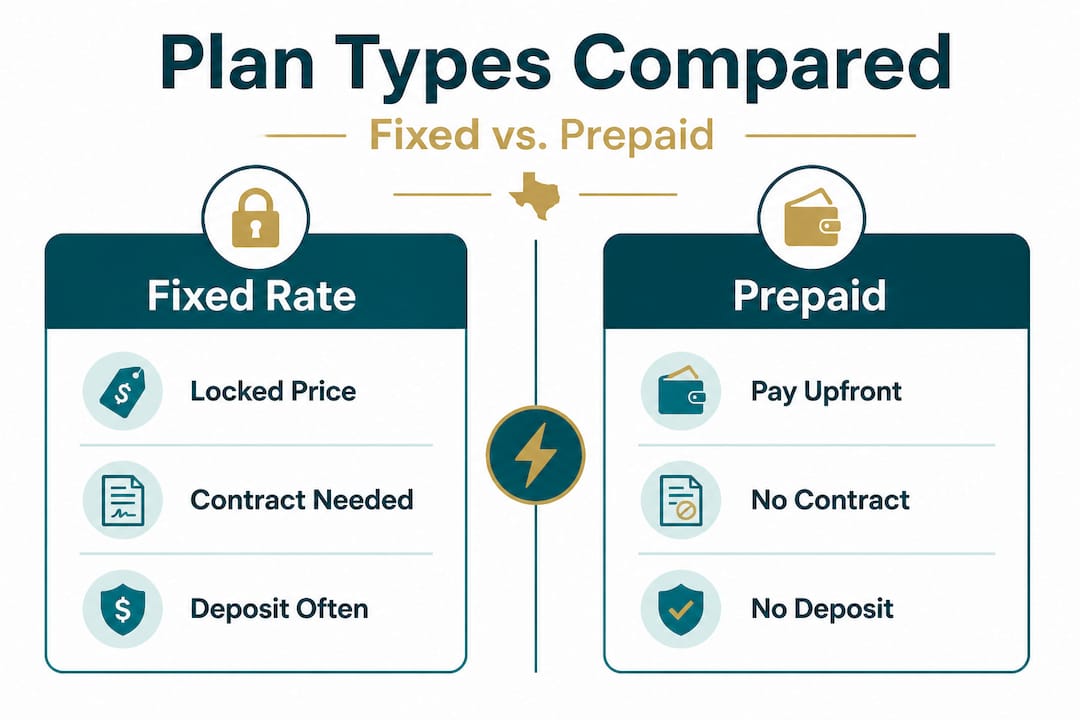
Fixed rate plans are popular for budget-conscious households who want predictable bills. You lock in a rate per kWh for a set period. The downside is that most fixed plans require a credit check and possibly a deposit, and breaking the contract early can mean a termination fee.
Variable rate plans shift with wholesale energy market prices. They’re usually contract-free and can work well for people who actively monitor usage and the market. However, during Texas heat waves or cold snaps, variable rates can spike dramatically. These variable plans carry real risk if you’re not watching them closely.
Prepaid plans are where things get genuinely useful for a large chunk of Texas residents. According to real enrollment patterns, prepaid plans offer immediate activation and require neither deposits nor credit checks, making them ideal for renters, people rebuilding credit, or anyone moving to a new place quickly.
Here are three real-world scenarios where prepaid wins:
- New mover in a hurry: You close on a lease Friday afternoon and need power on Saturday. Most traditional providers won’t activate that fast. Prepaid plans can often go live the same day.
- Short-term stay: You’re subletting for three months. Signing a 12-month fixed contract doesn’t make sense. Prepaid lets you use power on your schedule with no penalty to stop.
- Rebuilding credit: A credit check at the wrong time can feel like a barrier. Prepaid plans remove that barrier entirely.
Statistic to note: Many Texas residents don’t realize they can activate electricity the same day they apply for a prepaid plan. That speed advantage matters enormously when you’re in the middle of a move or an emergency situation.
Pro Tip: Before choosing between plan types, use a plan comparison tool to see total estimated monthly costs across your actual usage level. A plan that looks cheap at 500 kWh might be costly at 1,100 kWh. Always check the comparing Texas energy plans options side by side before committing.
Billing essentials: Fees, rates, and top terms to watch
Choosing a plan is only half the battle. Knowing what you’ll actually pay and why is just as important.
Even after picking a prepaid or no deposit plan, your first statement can feel puzzling if you don’t understand the charges itemized on it. The prepaid billing factors that affect your total go beyond just the rate per kWh. Understanding all charges prevents unexpected costs and allows better budgeting.
Here are the critical fees and terms to watch:
- TDSP delivery charge: A pass-through fee from your utility’s distribution company. This isn’t controlled by your REP and varies by region. It typically shows up as a cents-per-kWh charge or a fixed daily fee.
- Daily base charge: Some prepaid plans charge a small flat fee every day regardless of how much electricity you use. Even a $0.50 daily charge adds up to $15 per month before you use a single kWh.
- Reconnection fee: If your prepaid balance hits zero and your power disconnects, getting it back on may cost an additional fee on top of reloading your account.
- Minimum usage fee: Some plans charge extra if your usage falls below a certain threshold in a billing period. This matters if you’re away for part of the month.
- Late fee: For prepaid plans this is less common since you pay upfront, but some providers with hybrid prepaid structures may still apply them.
The terms “rate per kWh,” “service fee,” and “daily charge” all appear on Texas electricity statements but mean very different things. Your rate per kWh is what you pay for each unit of electricity consumed. Your service fee is often a fixed charge to maintain your account. Your daily charge is a flat fee assessed each calendar day.
You can also review your flexible payment options to find structures that give you more control over when and how much you pay. Some prepaid providers allow you to set auto-recharge thresholds so your account never hits zero unexpectedly.
Pro Tip: Always request a sample bill or Electricity Facts Label (EFL) before enrolling. The EFL is a standardized document Texas providers are required to publish. It shows average monthly costs at 500, 1,000, and 2,000 kWh usage levels so you can compare apples to apples across different providers.
The truth most Texans miss about electricity terms
Here’s where most guides stop. They give you the definitions and send you off to shop. But there’s a practical reality that only shows up after you’ve helped thousands of Texans navigate their electricity choices.
Most residents fixate on the advertised price per kWh and nothing else. That’s understandable. It’s the biggest number on the page. But it’s also the one number providers can engineer to look attractive while layering in fees that push your actual cost much higher. That’s not an accident. It’s how the game is played.
The people who get the best outcomes aren’t the ones who found the lowest advertised rate. They’re the ones who asked for the full picture before signing up. They read the EFL. They asked whether TDSP charges were bundled in or added separately. They confirmed whether a daily base charge applied. They asked what happens when their balance runs low.
Here’s the contrarian truth: prepaid and no deposit plans aren’t just for people who have bad credit or no savings. They’re often the smarter choice for anyone who wants total control and zero surprise bills. When you pay as you go, you naturally pay more attention to your usage. You notice when your bill is unusually high. You catch problems faster. That awareness has real financial value.
And the easy sign up tips that make the biggest difference aren’t about clicking through quickly. They’re about slowing down for five minutes to read the key terms before you commit. That five minutes is worth more than hours of frustration after the fact.
The smartest question you can ask any electricity provider before enrolling is simple: “Can you show me what a real bill looks like for someone using 1,000 kWh per month?” If they can answer that clearly and completely, you’re in good hands.
Fast, flexible electricity options: Get started today
You now have a solid working vocabulary for Texas electricity plans. You understand REPs, TDSPs, prepaid billing, and what fees to watch for. That knowledge is genuinely useful the moment you start comparing plans.

The next step is putting that knowledge to work. If you need power fast, with no deposit and no credit check required, no deposit electricity options are available today across major Texas cities. Whether you’re moving into a new place, handling an emergency, or just want the simplicity of paying as you go, same day power connection is within reach. Residents along the Gulf Coast can also find Palacios prepaid services with local utility support already in place. Browse your options, use your new knowledge, and activate with confidence.
Frequently asked questions
What does TDSP stand for on my Texas electricity bill?
TDSP stands for Transmission and Distribution Service Provider, the company that maintains the power lines and delivers electricity to your home. This is a critical separate fee from your energy provider’s charges and covers line maintenance and local service delivery.
Can I get electricity in Texas without a deposit or credit check?
Yes, prepaid electricity plans allow activation without a deposit or credit screening. Prepaid plans are designed specifically for those who want to avoid both barriers and just pay for energy as they use it.
What are the main fees to watch out for with prepaid plans?
Look out for daily base charges, TDSP delivery fees, and reconnection or late payment fees. Key billing factors with prepaid energy include all three, and they can add up quickly if you’re not tracking them.
What does “no deposit” actually mean when choosing electricity?
“No deposit” means you can activate service without paying any upfront cash before your electricity is turned on. No deposit options make energy access faster and more accessible, especially for new residents or those on tight budgets.
How quickly can I activate electricity on a prepaid plan?
Most prepaid plans offer same-day activation, meaning you can get power turned on within hours of signing up. Same-day activation is one of the top advantages prepaid electricity offers Texas residents over traditional plan types.