

TL;DR:
- Texas offers fully regulated no deposit electricity plans for residents with limited credit or moving.
- Prepaid plans enable same-day activation, budget control, and protections during extreme weather.
- Eligibility for deposit waivers depends on age, payment history, or participation in certain benefit programs.
Many Texans assume you need a solid credit score and a few hundred dollars upfront just to turn on the lights. That assumption is wrong, and it stops a lot of people from exploring options that could save them time and money. Texas is one of the few states with a fully deregulated electricity market, which means competition keeps providers honest and gives you real choices. Whether you have limited credit, no credit, or just moved to a new city, there are plans built specifically for your situation. Here’s what you need to know before you sign anything or pay anything.
Table of Contents
- How no deposit electricity works in Texas
- Top benefits of no deposit electricity plans
- Who qualifies for deposit waivers and no deposit plans
- How to avoid pitfalls: common challenges with no deposit electricity
- Our perspective: The real reason no deposit plans matter in 2026
- Get started with a no deposit plan today
- Frequently asked questions
Key Takeaways
| Point | Details |
|---|---|
| Instant access to power | No deposit plans let you activate electricity service on the same day, even with low or no credit score. |
| Special protections apply | Texas law grants deposit waivers for seniors, on-time payers, benefit recipients, and vulnerable customers. |
| Know eligibility requirements | Documentation and location matter—eligibility depends on your city, history, and benefit status. |
| Avoid common pitfalls | Watch for switch holds and always verify if your address qualifies before enrolling in a plan. |
How no deposit electricity works in Texas
Texas deregulated its electricity market in 2002, which means most residents can choose their own retail electricity provider. Providers compete for your business, and that competition created space for more flexible products, including plans that don’t require a credit check or deposit. This is not a loophole. It is a legitimate, regulated market option.
No deposit electricity plans are designed for customers who either can’t afford an upfront payment or simply prefer to skip it. Two main paths lead to deposit-free power: qualifying for a legal deposit waiver or signing up for a prepaid plan. Both are valid, both are regulated, and both can get you power fast.
No deposit electricity plans fall under the umbrella of PUCT oversight, meaning providers can’t just charge whatever they want or cut corners on consumer protection.
Deposit waivers are not random. Deposit waivers exist under PUCT Rule §25.24, which outlines exactly who qualifies. The groups protected include:
- Customers aged 65 or older
- Customers with 12 consecutive months of on-time payment history
- Recipients of TANF, Medicaid, or SSI
- Victims of family violence with supporting documentation
If you don’t fall into one of those categories, a prepaid plan is your best option. Think of prepaid electricity like a pay-as-you-go phone plan. You load money onto your account, and the system draws from that balance as you use power. There’s no credit check, no long-term contract, and in most cases, prepaid electricity options allow you to activate service the same day you sign up.
“Prepaid electricity customers are entitled to the same consumer protections as postpaid customers, including weather-related shutoff protections and proper advance notice before disconnection.”
Under Texas prepaid rules, providers must give you clear notice before your balance runs low and before any disconnection occurs.
Pro Tip: Before you agree to pay any deposit, call your provider and specifically ask whether you qualify for a waiver. Many customers pay deposits they didn’t need to pay simply because they didn’t ask.
Top benefits of no deposit electricity plans
Once you understand how these plans operate, you can see why demand is surging among credit-challenged Texans. Here’s what makes these options stand out.
Immediate activation with no credit barriers. Most prepaid plans let you start service the same day. You don’t wait days for a credit review or scramble to gather financial documents. If you’re moving into a new place or just lost service, that speed matters.

No large upfront costs. Traditional postpaid plans can require deposits of $150 to $300 or more depending on your credit history. A prepaid plan lets you start with a smaller initial load, keeping your cash where you need it.
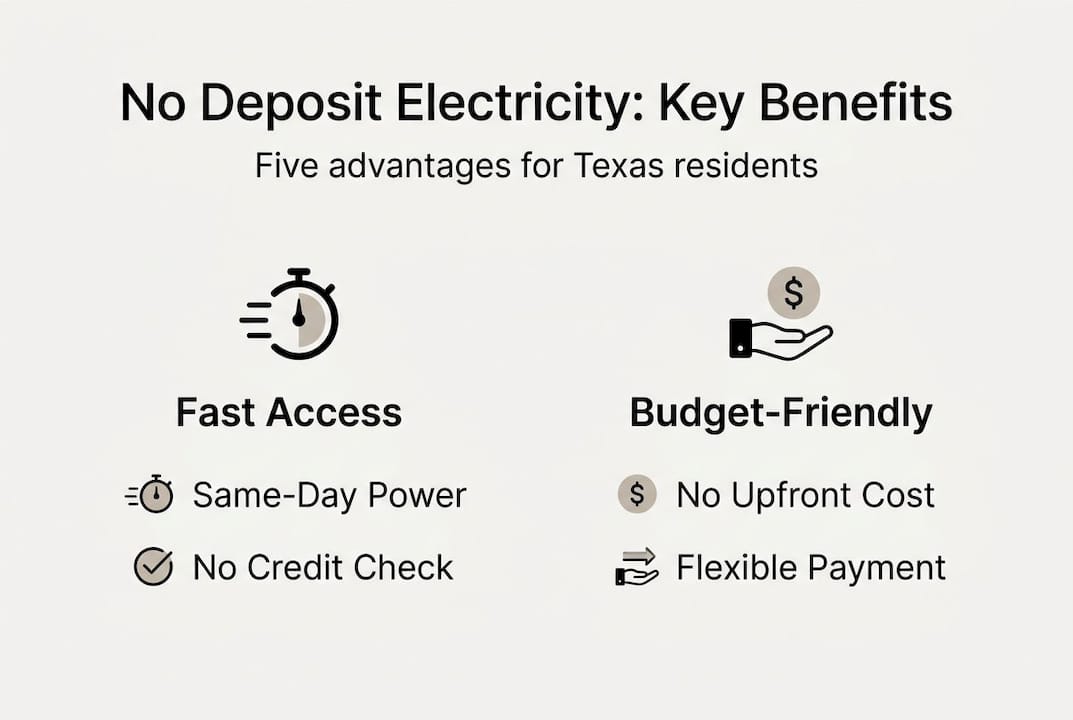
Full control over your payment schedule. You decide when and how much to add to your account. That kind of flexibility makes budgeting easier, especially if your income comes in irregular intervals.
Protection from weather-related disconnections. Texas prepaid electricity rules prohibit disconnections during extreme heat and cold snaps. This isn’t a courtesy, it’s the law. Even on a prepaid plan, your power stays on when temperatures hit dangerous levels.
Easy provider switching. Texas deregulation means you can switch providers if you find better no-deposit plan rates without being locked into a long contract. Prepaid plans typically run month-to-month, giving you maximum mobility.
Here’s a quick summary of why these plans work for so many Texans:
- Same-day activation in most deregulated cities
- No credit check required for prepaid enrollment
- Real-time usage alerts to monitor your balance
- Month-to-month flexibility with no cancellation penalties
- Flexible energy solutions available across major Texas metro areas
Also worth noting: the deposit waiver rule under PUCT creates a legally enforceable floor for consumer rights that no provider can ignore.
Pro Tip: Set up text and email alerts with your prepaid provider so you get notified when your balance drops below $20. Running out mid-month is avoidable with a simple notification setting.
Who qualifies for deposit waivers and no deposit plans
Not everyone is asked for a deposit. Let’s clarify who actually qualifies for these benefits and what you’ll need to prove eligibility.
Under state law, age 65+ and on-time history are among the strongest automatic waiver triggers, along with active enrollment in qualifying benefit programs and documented family violence situations.
Here’s a breakdown of who qualifies and what documentation is typically required:
| Qualifying group | Documentation needed |
|---|---|
| Age 65 or older | Government-issued ID showing date of birth |
| 12 months on-time payment | Account history from previous provider |
| TANF recipient | Current benefits award letter |
| Medicaid recipient | Current benefits card or letter |
| SSI recipient | SSA benefits confirmation letter |
| Family violence victim | Court order or certification from shelter |
If you believe you qualify but your provider denied your waiver request, here’s what to do:
- Ask the provider in writing for a specific reason for the denial.
- Pull together your documentation and resubmit through formal channels.
- File a complaint with PUCT if the denial appears to violate your rights.
- Look into affordable electricity plans that bypass the deposit issue entirely through a prepaid model.
One important limitation: deregulation only applies to parts of Texas. Cities served by municipally-owned utilities, like Austin Energy and CPS Energy in San Antonio, are not part of the deregulated market. Residents in those cities cannot access competitive no deposit or prepaid plans from third-party providers. If you’re in Dallas, Houston, Fort Worth, or most other major metro areas, you have full access to Texas prepaid options.
How to avoid pitfalls: common challenges with no deposit electricity
As helpful as no deposit options are, there are still some traps and exceptions. Here’s what you need to know to avoid unpleasant surprises.
Switch holds are the biggest hidden obstacle. A switch hold is a block placed on your address by a current or former provider, usually because of an unpaid balance. Switch holds can block plan activation until the issue is resolved. Even if you sign up for a no deposit prepaid plan, service won’t start at an address under a switch hold. Always ask your new provider to check your address for a switch hold before you complete enrollment.
Prepaid plans disconnect at zero. If your balance hits $0 and you haven’t added funds, service will cut off. That said, PUCT consumer protection rules prevent disconnection during extreme weather conditions, so you won’t lose power during a dangerous heat wave or freeze just because your account ran dry.
Here’s a side-by-side comparison to help you decide which plan structure fits your needs:
| Feature | Prepaid plan | Traditional postpaid plan |
|---|---|---|
| Deposit required | No | Often yes ($150 to $300+) |
| Credit check | No | Usually yes |
| Activation speed | Same day | 1 to 3 business days |
| Contract length | Month-to-month | Often 12 months |
| Disconnection risk | At $0 balance | After missed billing cycle |
| Weather protection | Yes | Yes |
Other things to watch out for:
- Some providers charge a daily service fee on prepaid accounts instead of a per-kWh rate, which can add up fast during low-usage months.
- Energy rates vary by area, so compare before you commit, especially if you’re in East Texas no deposit service zones where pricing structures can differ.
- Residents in cities like Temple can look at Temple prepaid plans for localized options that match their specific utility territory.
Pro Tip: Before signing up, ask your provider directly: “Does my address have a switch hold?” Providers can check this in seconds, and it could save you from a frustrating delay on move-in day.
Our perspective: The real reason no deposit plans matter in 2026
Most articles about no deposit electricity focus on the financial side. Cheaper entry. No big upfront cost. That’s all true. But we think the bigger story is about something harder to quantify: control and dignity during hard moments.
When your finances are tight, having power isn’t just a convenience. It’s connected to health, safety, work, and your kids’ ability to do homework at night. A system that lets you access electricity immediately, without judgment about your credit score, changes the equation entirely.
Texas deregulation gives real consumer leverage. That leverage means you can walk away from a bad deal, pick a plan that fits your actual income cycle, and switch providers when something better comes along. People with higher incomes and good credit take that flexibility for granted. It should be available to everyone.
We’ve seen how fast things can change for a family. Job loss, medical bills, a move to a new city. The ability to get power on the same day you need it, and to be the best option for bad credit customers in Texas, isn’t just a product feature. It’s the whole point.
Get started with a no deposit plan today
If you’ve been putting off getting electricity service because of concerns about deposits or credit checks, you don’t need to wait any longer. Same Day Electricity offers no deposit electricity options designed for fast, hassle-free activation across Texas.

We cover major deregulated cities and utility territories, so whether you’re looking at Temple no deposit plans or need same day energy activation in a larger metro, we can get you connected quickly. No credit check. No deposit. No waiting. Just power when you need it.
Frequently asked questions
Who can legally get out of paying an electricity deposit in Texas?
Deposit waivers cover customers who are 65 or older, have 12 months of on-time payments, receive TANF, Medicaid, or SSI, or are verified victims of family violence. Documentation is required in most cases.
How quickly can I get power with a no deposit or prepaid plan?
Prepaid allows instant activation in most deregulated Texas cities, meaning same-day service is genuinely possible when you sign up before your provider’s daily cutoff time.
What is a switch hold and can it block my service?
A switch hold is a block placed on a service address by an unpaid balance with a previous provider. Switch holds block all plans until the outstanding debt is resolved, including no deposit and prepaid options.
Are there any cities in Texas where no deposit plans aren’t available?
Yes. Cities like Austin and San Antonio are served by municipally-owned utilities and are not part of the deregulated market. Non-deregulated cities cannot offer competitive no deposit or prepaid plans from retail electricity providers.
What happens if my prepaid electricity balance reaches zero?
Service is typically disconnected when your balance hits $0, but weather protection applies during extreme heat or cold, pausing shutoffs to keep residents safe during dangerous conditions.